Featured Post

Fix, Don’t Discard MCAS/PARCC

This fall I had one on one conversations with many of our state's leaders and experts on the misplaced opposition to testing in gen...

Showing posts with label Teenage. Show all posts

Wednesday, December 22, 2021

It matters who they know, not just what they know.


https://www.christenseninstitute.org/blog/how-an-asset-based-approach-to-building-students-networks-can-expand-their-opportunities/?utm_source=Ed%20Digest&utm_medium=email&utm_campaign=12%2F17%2F21


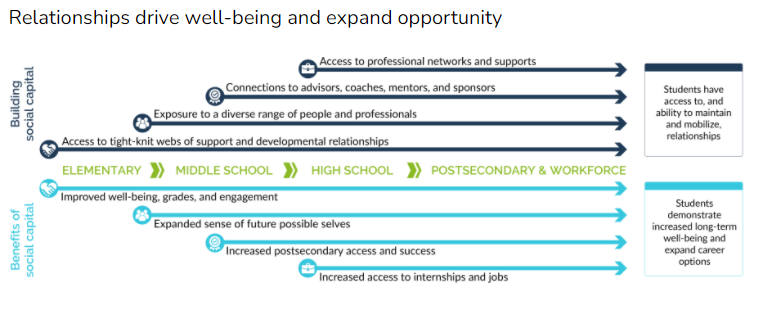
In recent years, the term “asset-based” has become increasingly popular in youth development and education lexicons. It marks an important, and arguably long overdue shift toward understanding and intentionally building on students’ strengths and talents, rather than focusing exclusively on their deficiencies. More often than not, however, calls to take a more asset-based approach in schools situate individual students as the locus of control and change. Individual strengths, experiences, and perspectives are celebrated and built upon.   But our research on social capital suggests that the concept of assets is accurate yet incomplete. The reality is that students’ assets reside not just within, but around them in their networks.

https://whoyouknow.org/playbook/take-stock/


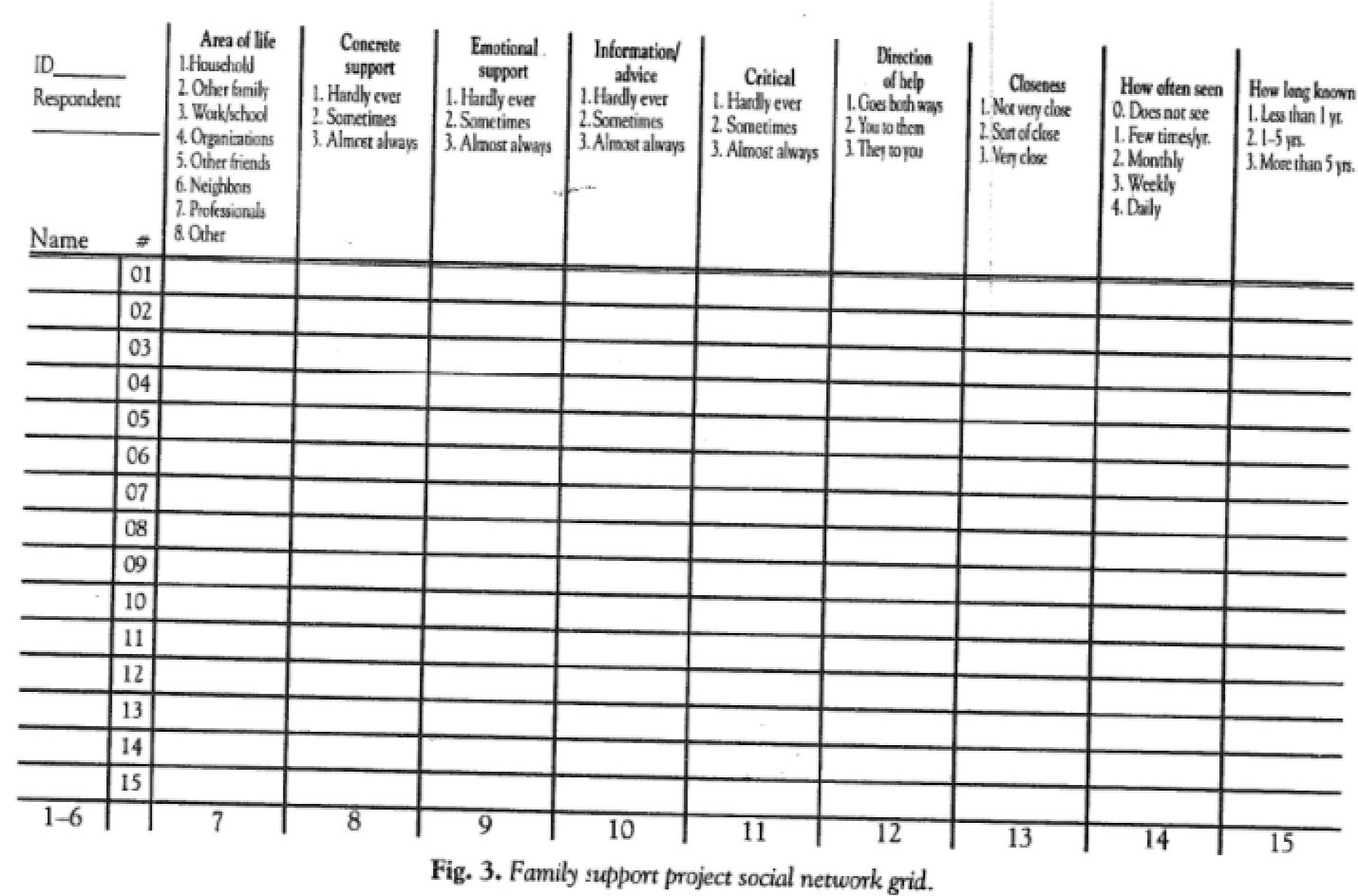
  1. If you want to understand broader networks that students have access to outside of your school or program → Try social network mapping: For decades, social workers have used asset mapping, a close cousin to relationship mapping, in order to assess the support networks of their clients. One example is the Social Network Map, developed by researchers Elizabeth Tracy of Case Western Reserve University and James Whittaker of the University of Washington. Their tool helps case managers identify and sort the structure and quality of a client’s support system by mapping relationships into several categories, including family, peers, friends, and co-workers. Researchers recommend doing multiple rounds of relationship or social network mapping because students may forget to include certain connections that make a difference in their lives. You can gain a more complete picture of who your students know and depend on by revisiting relationship and social network maps. Read more about this approach in the article “The Social Network Map”.

  1. If you’re trying to better understand relationships inside your school or department → Try relationship mapping protocols with your team and students:  Relationship mapping is a strategy that can help schools adjust their practices to effectively forge trusting relationships between students and adults. All it takes is a roster of student names and two sets of different colored stickers for staff to visualize patterns among whom they feel they have a strong relationship with and whom they believe may be at risk for academic, personal, or other reasons. Larger schools and institutions may prefer to move through the process one grade level or department at a time. You can also perform mapping exercises across both staff and students to compare the results. From there, schools that identify students who lack trusting relationships with adults or faculty can direct additional connections and resources accordingly. For example, watch Ted Dintersmith’s Innovation Playlist to see relationship mapping in action at Jamestown Public Schools.


  1. If you’re working in a resource-scarce, human capital-scarce environment → Use relationship and networking mapping as a student project to identify latent resources: Not only does relationship mapping provide more detailed information regarding whom your students know and turn to—it can also surface relationships that you could enlist more deliberately to expand supports or opportunities at your institution. Make sure you have a shared contact database where you can store these connections so that they remain within reach for your community to tap into in the future.


Tuesday, August 12, 2014

Cool at 13, Adrift at 23

Cool at 13, Adrift at 23

Photo
Credit Gianluca Fabrizio/Getty Images

 Top Stories

This article and others like it are part of our new subscription.
Learn More »
At 13, they were viewed by classmates with envy, admiration and not a little awe. The girls wore makeup, had boyfriends and went to parties held by older students. The boys boasted about sneaking beers on a Saturday night and swiping condoms from the local convenience store.
They were cool. They were good-looking. They were so not you.
Whatever happened to them?
“The fast-track kids didn’t turn out O.K.,” said Joseph P. Allen, a psychology professor at the University of Virginia. He is the lead author of a new study, published this month in the journal Child Development, that followed these risk-taking, socially precocious cool kids for a decade. In high school, their social status often plummeted, the study showed, and they began struggling in many ways.
It was their early rush into what Dr. Allen calls pseudomature behavior that set them up for trouble. Now in their early 20s, many of them have had difficulties with intimate relationships, alcohol and marijuana, and even criminal activity. “They are doing more extreme things to try to act cool, bragging about drinking three six-packs on a Saturday night, and their peers are thinking, ‘These kids are not socially competent,’ ” Dr. Allen said. “They’re still living in their middle-school world.”
As fast-moving middle-schoolers, they were driven by a heightened longing to impress friends. Indeed their brazen behavior did earn them a blaze of popularity. But by high school, their peers had begun to mature, readying themselves to experiment with romance and even mild delinquency. The cool kids’ popularity faded.
B. Bradford Brown, a professor of educational psychology at the University of Wisconsin-Madison who writes about adolescent peer relationships and was not involved in the study, said it offered a trove of data. The finding that most surprised him, he said, was that “pseudomature” behavior was an even stronger predictor of problems with alcohol and drugs than levels of drug use in early adolescence. Research on teenagers usually tracks them only through adolescence, Dr. Brown added. But this study, following a diverse group of 184 subjects in Charlottesville, Va., starting at age 13, continued into adulthood at 23.
Researchers took pains to document the rise and fall in social status, periodically interviewing the subjects as well as those who they felt knew them best, usually close friends. About 20 percent of the group fell into the “cool kid” category at the study’s outset.
A constellation of three popularity-seeking behaviors characterized pseudomaturity, Dr. Allen and his colleagues found. These young teenagers sought out friends who were physically attractive; their romances were more numerous, emotionally intense and sexually exploring than those of their peers; and they dabbled in minor delinquency — skipping school, sneaking into movies, vandalism.
As they turned 23, the study found that when compared to their socially slower-moving middle-school peers, they had a 45 percent greater rate of problems resulting from alcohol and marijuana use and a 40 percent higher level of actual use of those substances. They also had a 22 percent greater rate of adult criminal behavior, from theft to assaults.
Many attributed failed adult romantic relationships to social status: they believed that their lack of cachet was the reason their partners had broken up with them. Those early attempts to act older than they were seemed to have left them socially stunted. When their peers were asked how well these young adults got along with others, the former cool kids’ ratings were 24 percent lower than the average young adult.
The researchers grappled with why this cluster of behaviors set young teenagers on a downward spiral. Dr. Allen suggested that while they were chasing popularity, they were missing a critical developmental period. At the same time, other young teenagers were learning about soldering same-gender friendships while engaged in drama-free activities like watching a movie at home together on a Friday night, eating ice cream. Parents should support that behavior and not fret that their young teenagers aren’t “popular,” he said.
“To be truly mature as an early adolescent means you’re able to be a good, loyal friend, supportive, hardworking and responsible,” Dr. Allen said. “But that doesn’t get a lot of airplay on Monday morning in a ninth-grade homeroom.”
Dr. Brown offered another perspective about why the cool kids lost their way. The teenagers who lead the social parade in middle school — determining everyone else’s choices in clothes, social media and even notebook colors — have a heavy burden for which they are not emotionally equipped. “So they gravitate towards older kids,” he said. And those older teenagers, themselves possibly former cool kids, were dubious role models, he said: “In adolescence, who is open to hanging out with someone three or four years younger? The more deviant kids.”
Dr. Allen offered one typical biography from the study. At 14, the boy was popular. He had numerous relationships, kissed more than six girls, flung himself into minor forms of trouble, and surrounded himself with good-looking friends.
By 22, he was a high-school dropout, had many problems associated with drinking, including work absenteeism and arrests for drunken driving. He is unemployed and still prone to minor thefts and vandalism.
But as Dr. Allen emphasized, pseudomaturity suggests a predilection; it is not a firm predictor. A teenage girl from the study initially had a similar profile, with many boyfriends at an early age, attractive friends and a fondness for shoplifting.
Yet by 23, Dr. Allen wrote in an email, “she’d earned her bachelor’s degree, had not had any more trouble with criminal behavior, used alcohol only in responsible ways and was in a good job.”
Dr. Mitchell J. Prinstein, a professor of psychology at the University of North Carolina at Chapel Hill who studies adolescent social development, said that while teenagers all long to be accepted by their peers studies suggest that parents can reinforce qualities that will help them withstand the pressure to be too cool, too fast.
“Adolescents also appreciate individuality and confidence,” he said. “Adolescents who can stick to their own values can still be considered cool, even without doing what the others are doing.”