Featured Post

Fix, Don’t Discard MCAS/PARCC

This fall I had one on one conversations with many of our state's leaders and experts on the misplaced opposition to testing in gen...

Showing posts with label Somerville. Show all posts

Wednesday, December 22, 2021

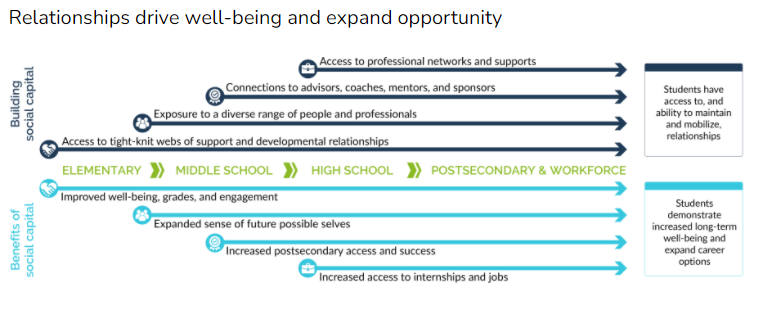
It matters who they know, not just what they know.


https://www.christenseninstitute.org/blog/how-an-asset-based-approach-to-building-students-networks-can-expand-their-opportunities/?utm_source=Ed%20Digest&utm_medium=email&utm_campaign=12%2F17%2F21


In recent years, the term “asset-based” has become increasingly popular in youth development and education lexicons. It marks an important, and arguably long overdue shift toward understanding and intentionally building on students’ strengths and talents, rather than focusing exclusively on their deficiencies. More often than not, however, calls to take a more asset-based approach in schools situate individual students as the locus of control and change. Individual strengths, experiences, and perspectives are celebrated and built upon.   But our research on social capital suggests that the concept of assets is accurate yet incomplete. The reality is that students’ assets reside not just within, but around them in their networks.


https://whoyouknow.org/playbook/take-stock/


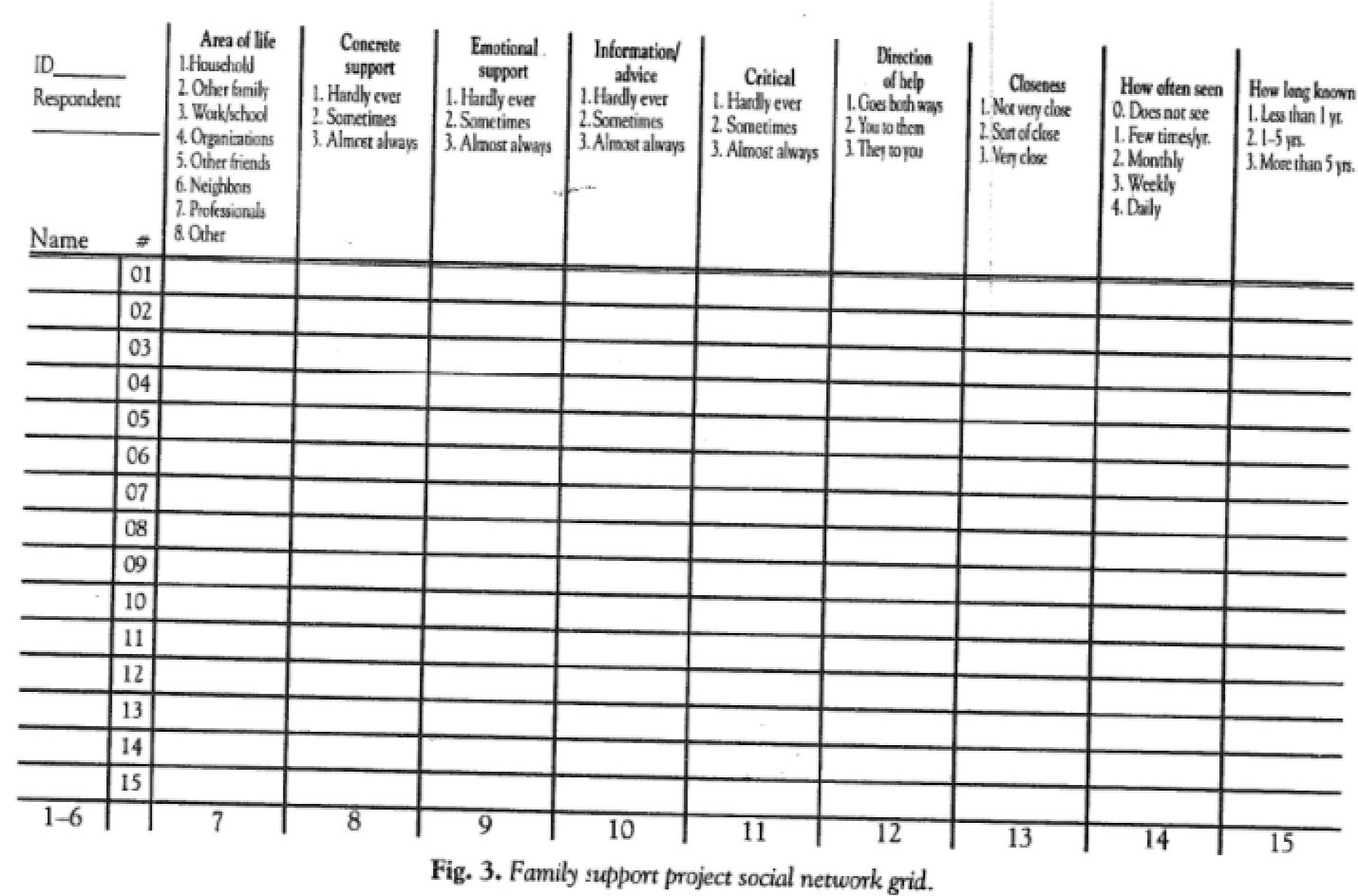
  1. If you want to understand broader networks that students have access to outside of your school or program → Try social network mapping: For decades, social workers have used asset mapping, a close cousin to relationship mapping, in order to assess the support networks of their clients. One example is the Social Network Map, developed by researchers Elizabeth Tracy of Case Western Reserve University and James Whittaker of the University of Washington. Their tool helps case managers identify and sort the structure and quality of a client’s support system by mapping relationships into several categories, including family, peers, friends, and co-workers. Researchers recommend doing multiple rounds of relationship or social network mapping because students may forget to include certain connections that make a difference in their lives. You can gain a more complete picture of who your students know and depend on by revisiting relationship and social network maps. Read more about this approach in the article “The Social Network Map”.


  1. If you’re trying to better understand relationships inside your school or department → Try relationship mapping protocols with your team and students:  Relationship mapping is a strategy that can help schools adjust their practices to effectively forge trusting relationships between students and adults. All it takes is a roster of student names and two sets of different colored stickers for staff to visualize patterns among whom they feel they have a strong relationship with and whom they believe may be at risk for academic, personal, or other reasons. Larger schools and institutions may prefer to move through the process one grade level or department at a time. You can also perform mapping exercises across both staff and students to compare the results. From there, schools that identify students who lack trusting relationships with adults or faculty can direct additional connections and resources accordingly. For example, watch Ted Dintersmith’s Innovation Playlist to see relationship mapping in action at Jamestown Public Schools.


  1. If you’re working in a resource-scarce, human capital-scarce environment → Use relationship and networking mapping as a student project to identify latent resources: Not only does relationship mapping provide more detailed information regarding whom your students know and turn to—it can also surface relationships that you could enlist more deliberately to expand supports or opportunities at your institution. Make sure you have a shared contact database where you can store these connections so that they remain within reach for your community to tap into in the future.


Saturday, November 23, 2013

Arne Duncan to suburban moms


Education Secretary Arne Duncan told an audience of state superintendents this afternoon that the Education Department and other Common Core supporters didn’t fully anticipate the effect the standards would have once implemented.

“It’s fascinating to me that some of the pushback is coming from, sort of, white suburban moms who — all of a sudden — their child isn’t as brilliant as they thought they were and their school isn’t quite as good as they thought they were, and that’s pretty scary,” Duncan said. “You’ve bet your house and where you live and everything on, ‘My child’s going to be prepared.’ That can be a punch in the gut.”

Friday, October 11, 2013

How to be a Hipster


Edited by Jellybones, Sondra C, Keyboard_Cat, Krystle and 152 others


Hipsters are people who enjoy clothing, music, food and activities outside of the social mainstream. If you want to embrace a lifestyle of independent music labels, vintage clothes, and artisanal coffee, read the guide below.

Steps

Hipster Fashion

  1. 1
    Dress like a hipster. Fashion is just as important as your taste in music. While shopping at vintage stores remains a staple for many hipsters, this is not a given, nor does it need to be a part of the hipster wardrobe.


    • Know the labels. Several labels cater to the hipster scene; the more well-known include American Apparel, H&M, ASOS, CobraSnake, and Urban Outfitters.
    • Avoid buying labeled gear from stores run by the label itself (so very not nice consumerism). Instead, look for independent retailers because supporting obscure retailers is "totally deck". For example, buy from local mixed fashion stores near you.
  2. 2
    Wear skinny jeans. The classic "skinny jeans" make the hipster look, both for males and females. Hipster men tend to be as skinny as the women.


    • Note that guy hipsters actually probably wear skinny jeans more than the girls (girls prefer leggings/jeggings/treggings).
    • Alternatively, for women, high-waisted pants (a.k.a. "mom jeans") may also be worn.
  3. 3
    Wear glasses. Hipsters love ironic eyewear such as shuttershades, oversized plastic framed glasses, Buddy Holly glasses, nerd glasses, and — for those who can afford it — authentic Ray Ban Wayfarers in all the colors of the rainbow.


    • Some hipsters wear eyeglasses even though they have 20/20 vision! In this case, pop out the lenses or make sure they're just regular glass.
  4. 4
    Wear ironic tops. For tops, the following are good picks: ironic tees, plaid shirts, cowboy shirts, and anything in gingham, plaid, checkers, paisley, vintage florals.


    • Many hipsters sport tops with appliques, images of animals or forests, other images, characters from children's TV, and ironic sayings or even book covers.
    • Fitted hoodies are perfect, too.
  5. 5
    Dress vintage. Dresses are good for women, preferably vintage floral or lace. Granny's closet is definitely a good source; however, you should know how to sew and restyle vintage clothing to fit you.


  6. 6
    Find suitable footwear. Hipster shoes include cowboy boots, Converse, and a range of flats.


    • Converses are no longer universal. They look great and you can wear them pretty much anywhere, but since everyone wears them, Doc Martens or any other vintage shoes are better.
    • If it's trainers you're after, see Classic Reeboks.
    • For girls, heels aren't the most popular but feel free to wear them. Cute sandals, Keds, boots, and granny boots are not only more practical but also show how little effort you've put forth (even if it took you ages to find the perfect pair).
  7. 7
    Accessorize. There is a wide range of accessories, including large flower headbands, neon nail polish, pins, bright belts, bird necklaces, patterned and colorful leggings, etc.


    • Don't forget your plugs, piercings, and random scars supposedly acquired through woodwork and other carpenter-like endeavors.
    • Appropriately ironic accessories are mandatory, such as things kids would take to school, like an animal image on a lunchbox.
    • Essentials include a courier bag (not a backpack), preferably something from Freitag, that can fit your MacBook, iPhone, and vinyl LPs (never CDs) of your current favorite band.
  8. 8
    Mismatch and layer. Layering or wearing things that don't match together is very hipster. It's that "I can't be bothered" look that actually takes some planning until you get into the habit.


    • Remember that a hipster's outfit never needs adjustment should you decide to go to the beach — keep all of your urban accompaniments for the sand and surf to ironically stick out of your element.

Hipster Health

  1. 1
    Ignore the comments about improper hygiene. Some people associate hipsters with hippies and assume that they don’t shower regularly or otherwise don’t practice proper hygiene. This is a misconception. Though some hipsters participate in the no shampoo movement (which is still very clean), most practice normal hygiene (with bonus artisanal and environmentally-friendly soaps!).


    • While hipsters do shower regularly and clean their teeth, they're just less interested in forking out money for hairstyling, spa sessions, pedicures/manicures, and large make-up kits because these are signs of conforming to cultural ideals of beauty.
    • Arguably, hipsters aren't so interested in "making the most of their assets" because they see their entire self as an asset; from a self-esteem point of view, this is actually a rather healthy outlook.
  2. 2
    Keep your hair casual. Messy hairdos are just fine. The "bed look", long unkempt hair, and hair that resists any attempts to stay flat without chemicals are acceptable looks.


    • Blurring gender lines with haircuts and styles is part of the hipster culture.
    • Greasy hair is considered okay by some in the hipster culture. That doesn't mean you need to concur and a squeaky clean but uncombed do might be more your thing.
    • Some hipsters like to dye their hair in an obvious way.
  3. 3
    Take a green approach to food. Consider growing your own food or turning vegetarian. Use compost if possible. Eating meat isn't always popular with the hipster culture, and many hipsters tend to be vegetarian or vegan. If you do eat meat, you must assert that choice as a cynical transcendence of vegetarians' futile attempts to save the world.


    • Fruit, coffee, Asian food, etc., are all hip foods.
    • If you have absolutely no space to grow your own produce (not even a balcony or a window sill), go to a natural foods market instead.
    • Often, hipsters are alsofoodies and love making gourmet meals. If you can't cook, consider getting some good cookbooks today.

Hipster Lifestyle

  1. 1
    Become a master of reuse. This takes a mixture of frugality, respect for some of the past, and a desire to demonstrate that new things don't define you. Naturally, you'll need to wrestle with the inconsistency of this step with the fact that loving shiny new Apple products and brand new clothes from certain labels is also a side of a true hipster, but since we're all contradictory deep down, the sooner we grasp these contradictions and accept them, the more whole a person we'll be.


    • Commonly known old things associated with hipsters include Parliament cigarettes (and a devil-may-care attitude about smoking laws), Pabst beer, grandparent's clothing (or thrift store finds), bicycles with fixed gears (often ridden to the night clubs), analog cameras, and recycling and reusing almost anything (ingenuity, common sense, and fun comes into this).
  2. 2
    Reject blind consumerism. Hipsters are into "niche consumerism". If your purchase helps local retailers, the environment, the mom and pop retailer, and the craft sellers down the road, then it's hipster.
  3. 3
    Be aware that most hipsters exist in a certain age group. Hipsters tend to be in their teens through to their 30s. This is part of today's "extended adolescent" era, consisting of existential angst, searching for purpose and inner worth, and asking the meaning of everything.
    • Of course, this doesn't mean you can't be a hipster at an older age, but the fact that as you age you get less bothered and upset about the way the world works, or doesn't work, probably means you're a) not so keen to be labeled anything, b) not in need of belonging to any sub-culture, and/or c) less angry than you used to be. It's quite possible you're also very discreetly steering the rudder of your own teens going through "issues" and you're less than keen to adopt more of the same for yourself.
  4. 4
    Be where the hipsters roam. Hipsters tend to congregate in very urban settings and they're connected globally thanks to the Internet. In the USA, you'll tend to find hipsters in major metropolitan centers where "anything goes". Be where there are independent art galleries, movie houses, bands, and people.


    • Think New York City, Chicago, San Francisco, Portland, Seattle, Minneapolis, and especially the Brooklyn, N.Y. suburb of Williamsburg (known as the unofficial hipster capital of the world).
    • Places like Glasslands and Pianos will be right up your alley.
    • Los Angeles is also acceptable but be careful not to get sucked into the California culture.
    • For less urban USA, try to find any moderately large college town; and in some states, a college town might be the only liberal part of the state such as Austin, TX, or Lawrence, KS.
    • In the UK, London is your spot, in Canada, try Montreal[1], and in Australia, try Melbourne.[2]
    • Do not force yourself to live or go to these places or countries for the sake of being a hipster. Besides from being too uneconomical (especially if you live on the other side of the world), you can actually begin being a hipster in your place. One of the advantages is if your place knows less about hipsters, the fewer the people who will be discriminating or criticizing you. Take note that the Internet will always be your best friend.
  5. 5
    Be educated. Aim to go to college, as hipsters tend to be well educated in such areas as liberal arts, graphic art, or math and science.


    • Do a lot of reading, even if it means sitting in the local bookstore using their space and not actually purchasing the books you're siphoning up knowledge from. Seek to go to higher level education if you're in your element at college.
    • Hipsters are a subculture that uses more of their right brain than the rest of the society, thus, many hipsters base their career choices around music, art, or fashion. While these areas of work aren't essential choices, they are probably a natural outlet for a hipster's creativity.
    • Education is what helps a hipster to be dismissive about the hue and cry of others; they know it's just history repeating itself, or it's all much ado about nothing.
  6. 6
    Be an early adopter. Hipsters tend to sense what's worthwhile before the trend or item becomes more popular. Many bands become famous only after hipsters first flock to their unknown performances. Many clothing trends were started by hipsters, only to be hijacked later by mainstream fashion houses. Many technical gadgets are taken up by hipsters first, only to become mainstream goodies later.
    • Of course, the irony of being an early adopter hipster is that once the trend or item becomes mainstream, it's time to move on to something else obscure and unrecognized. That's the trouble with being such an independent spirit; you trailblaze but you also have to keep moving on.
    • If you're really good at something like math, physics, medicine, psychology, political analysis, eco-awareness, etc., you might find yourself making amazing discoveries that are light years ahead of everyone else's thinking. You know deep down that you've cottoned onto something that really matters and that it makes sense but others are not convinced because it's the "great unknown". Rest easy and be determined in your knowledge that some day, others will come round to your discovery.
  7. 7
    Don't define yourself to others. One of the key elements of being hipster has been to avoid the label. Don't go around proclaiming your allegiance; to do so would be to start allying with those who like neatly tied-up boxes denoting who is what, when, and where.
    • The moment you define yourself too clearly is the moment you begin to stagnate and risk being captured by the status quo. Many a hipster will therefore deny their "hipster-ness" whenever possible.
    • To preemptively ward off the mockers, some hipsters have taken to extending their sense of irony to include even themselves by acknowledging and mocking their own hipsterdom (for example, wearing a tee that says "I hate hipsters"); that way, by mocking themselves first, no one else can effectively do it.
  8. 8
    Keep a pulse on the hipster community. There is a strong community aspect to hipster culture. If you want to find out about the best new bands or a great local coffee shop, make sure to stay active in the community to get good recommendations and stay ahead of the trends.


    • When some new, obscure band is on Pitchfork (preferably before), you should know about it.
    • Check out Brooklyn Vegan (even if you don't live there), Stereogum, Gorilla vs. Bear, and the Hype Machine as often as possible, but don't make it obvious that you check them every five seconds.

Indie Entertainment

  1. 1
    Read hipster classics. Your reading sources are important because what you read connects you with other hipsters, informs you about cultural issues, and keeps you knowledgeable. There's a lot to be read out there, so sort the wheat from the chaff and get into the things that matter most. Things to read include:


    • Hipster magazines, such as Vice, Another Magazine, and Wallpaper.[3] Foreign magazines are good too.
    • Great books and poetry by people like Jack Kerouac, Alan Ginsburg, and Norman Mailer. Any other books you think are great. Any books, period; reading books sets hipsters apart from a lot of people. Visit the political science, anthropology, and sociology sections of the bookstores and local library frequently.
    • Blogs by other hipsters. You might also be inspired enough to write your own blog frequently.
  2. 2
    Watch hipster cinema. Watch independent and foreign films, as well as attending independent theater productions, such as shows by Ann Liv Young. Watch Wes Anderson, Hal Hartley and Jim Jarmusch movies.
  3. 3
    Listen to newly emerging, independent music. Indie music is a big part of what being a hipster is all about. Turn to the endless and ever-renewing list of independent artists in the music scene, especially in the areas of nu-rave, minimalist techno, independent rap, nerdcore, Elephant 6, garage rock, classic rock (Beatles usually), and punk rock.


    • Hipster artists of note include Animal Collective, Grizzly Bear, Belle & Sebastian, Electric President, Stray Kites, Jens Lekman, Neutral Milk Hotel, M83, Neon Indian, Neon Neon, Margot & The Nuclear So and Sos, and King Khan and the Shrines.
    • Music blogs like Gorilla vs. Bear, Indiehere, /mu/, and Stereogum may help you with choosing suitable bands to listen to. Meeting people who are already into these bands will help you as well.
    • Perhaps the most popular hipster music website is Pitchfork Media. If they give an album a good rating, it must be quite hip.
    • One good way to decipher whether or not an artist is hipster is if your non-hipster friends to have never heard of them.
    • Feel free to listen to the music of other countries as well, since most mainstream songs of this decade came out of America, Britain and South Korea.

Socializing

  1. 1
    Use social media. Female hipsters love to use Blogspot, Tumblr or Wordpress, as well as taking photos with their Holga cameras and making cross-processed and "dream-like" pictures. Social media can also be a great way to find new things to enjoy, before they become mainstream.


  2. 2
    Date other hipsters. The reason to "hook up" with other hipsters is that you're much more likely to connect and see eye-to-eye on a range of issues. The all-American muscle guy or sorority-style tanned blond are not likely to be your type, so a fellow hipster is the answer.


  3. 3
    Start dancing. If you want to spot a hipster, just turn around the next time you're at a show and see them standing in the back discussing Stella or Pabst Blue Ribbon (PBR) in a can. Sometimes, if the music and setting is right, you will witness hipsters engaging in dance movements.

    • Hipster dancing, if done right, does not use so much of the hips as it does the upper body and arms. Lots of swinging your head back and forth but only do this if you're not humiliated easily (and as a hipster, you really shouldn't care).
    • Although you'll rarely see hipsters dancing at shows, they tend to enjoy separate dance parties where they can dance to an array of more upbeat hipster dance music.
  4. 4
    Get the lingo and the attitude. While there will be many variations—part of the reality of hipster culture is that things change constantly—there are some things that are useful to know:
    • Remember to use perhaps the most important hipster line: "I liked them before they were cool." Another good line given the recent spate of disasters is to say something like: "I donated to Haiti... before the disaster."
    • Namedrop often. Talk about all the obscure bands you like that nobody you know has heard of. When your friends talk about a band you're unfamiliar with, just say you've heard of them but not actually heard them. Look them up the next time you have a chance to. It'll give you more cred.
    • Insult a lot of bands. If you love everything you'll seem like a fanatic. Make sure to give off a vibe that you're too cool and elite for a lot of bands.
    • If you would like to seem more educated and elite there is the key phrase " I liked their first EP, but pretty much after that I never got into them."
    • Use made-up words as often as possible. Or use real words that no one really knows the meaning of unless they look them up (eg. pulchritudinous, cordiform, and petrichor).
  5. 5
    Hone your humor. A hipster is known for their strong sense of irony and sarcasm. When asked a question, refuse to answer directly; instead, obfuscate, ask a question in return, or just be plain sarcastic.


    • Be sure to layer on the smirk to indicate your lack of seriousness, because it's possible for the other person to mistake your sarcasm for sincerity.
    • For example: When in a theater watching a movie, and the person next to you turns to say, "Oh, my God, that was so cool! Did you see that?", in a dry tone, reply something along the lines of, "No, I paid $12.50 to stare at the ceiling."
    • Watch British comedies for examples of good uses of sarcasm you can borrow.
    • Have a sense of humorous perspective and don't take yourself too seriously. Hipsters are often parodied, so knowing how to laugh at derision will help a lot.
  6. 6
    Be prepared for critics. Be aware that hipsterism is frequently parodied or derided because hipsters bother some people. You're going to need to get used to disdainful attitudes and to work out the ways in which you're most comfortable responding.


    • There will often be an insistence that your sub-culture is "less than" whatever it is the hater "believes" in.
    • Given the tendency for hipsters to follow progressive politics, it's likely you'll encounter occasional conservative disdain, so it's probably a good idea to brush up on your responses to any standard ridicule.
    • As for people who poke fun at your fashion sense, remind the so-called trendy mass that their worn and torn jeans fashion was created by children who are little more than slaves in some sweatshop and if they want to contribute to that, they’re welcome to.
    • Recognize the root of the problem. Realize that a lot of people who attack you may have deep insecurities about their own place in society and have very mixed ideas of what culture is, or how they reconcile the variant elements of culture with their own lifestyle and preferences. Practice a little compassion.
    • Know that geeks have an odd relationship with hipsters. While some are disdainful, other geeks recognize the overlap of the cultures.[4]
       

    Tips
  • Always find alternatives for everything when your favorite item or artist turns mainstream.
  • Rather than going to Starbucks for coffee, go to a local shop or make your own at home to boost up your hipster cred. Carry around a durable thermos cup for your homemade coffee; if it has a sticker against genetic engineering on the side, so much the better.
  • Don't listen to any songs that don't have a deep and depressing lyrical vibe.
  • Buy a Mac, Apple TV, and an iPad. The iPod and iPhone are too mainstream now, so for your smartphone, pick up a Windows Phone, preferably from a hip brand like Huawei. Chinese manufacturers only!
  • Go to shows — music, drama, opera, poetry, comedy, gladiators. The more, the better.
  • Don't drive an expensive car. Don't even own a car at all. It is a waste of gas and money and parking will frazzle your brain. Ride a bike instead - make it a fixed or single gear bike. The fixed-gear bicycle should have skinny tires, genuine Brooks leather saddle and no front brake. Even if you do not own a bike (i.e., drive a car), make sure to roll up your right pant leg to give off the appearance that you just crossed town without increasing your carbon footprint. The rolled-up pant leg is not complete with your carabiner jangling with as many keys as possible. The more you look like you work days as a messenger and moonlight as a janitor, the more hip you will be.
  • Many hipsters are interested in "geeky" subjects", like philosophy or film criticism. If you find things like that interesting, it increases one's hipster cred to bring them up in conversation.
  • Don't wear crocs.
  • There is a constant myth that hipsters live off their parents. Some might, just as some people might from many other sub-cultures, but equally a lot of hipsters happily make their own living.
  • It is common for hipsters to play instruments, and starting a band of your own is a great way to showcase your love of independent music. You don't have to be good; just be enthusiastic.
  • Do your own hair. The pudding basin is an excellent old-fashioned solution for a straight haircut if that's a problem for you. Simply up-end it over your head and use sharp scissors to cut your bangs or hair edge.
  • Be patient with habits you've recently given up and with new ones you are taking up. Luckily, It only takes about a month or two to get into the lifestyle.
  • Don't watch MTV all the time. You shouldn't use it as a way to find out about music. However, maybe watching some trashy reality show will be seen as ironic.
  • A simple and cheap way to achieve the eyeglasses look is to pop out the lenses of the thick, 3D glasses that theaters give out for 3D movies. Put on the glasses and you've got your eyeglasses! Plus, there won't be any lenses to get in your way.
Warnings
  • Don't take this article too seriously, instead see it as a set of guidelines to work with as befits you. Hipsters pride themselves on their independence from the mainstream.
  • Try not to take yourself too seriously.
  • The goal of being a hipster is to look like you're not trying, however, if you are one, you are probably trying really hard, or at least enough. Just accept it.
  • Negativity can pervade the hipster culture, perhaps as a counteraction to the ridiculously-positive, can-do motivational speaker style attitudes pervading much of the business and consumer culture these days. However, negativity is not an answer, it's simply a reaction. Always try to find balance and peace in your life rather than seeing doom and gloom in everything. Yes, society is full of problems but being negative about them won't solve or change such problems whereas a realistic and pragmatic approach to doing things that make a difference will go part the way to bringing about a better world. Remember too, that every generation is cursed with thinking things used to be or could be better. We are time-bound and body-bound creatures who need to accept our limitations while making the most of what we do know and can do. Constant deconstructing and criticizing of society can all too easily turn into a paralysis-by-analysis lifestyle, in which complaining becomes your modus operandi but actually changing the status quo is not something you're tooled up to do.
  • Sometimes, just sometimes, you may be really frustrated that other people don't get what's so great about your music, fashion, and other choices. Give it up; you won't ever see, hear, or feel the things they love the way they do, and that's because everyone is different.

Edit Things You'll Need

  • Hipster clothes (see above)
  • Plaid shirts
  • Scarves (to wear year-round)
  • Vintage boots
  • Tattoo
  • Turntable
  • An old camera (polaroid is suggested.)
  • Fixed-gear bike
  • Your own garden
  • Fountain Pen
  • Any Apple product always updated
  • Instagram (remember to add hashtags!)

Edit Related wikiHows


Edit Sources and Citations


Article Info

Featured Article
Categories: Featured Articles | Urban Styles
Recent edits by: sarah saieed, Little_birdy, Julia


Share this Article:


Thanks to all authors for creating a page that has been read 2,694,378 times.
Was this article accurate?
YesNo


Thursday, September 26, 2013

Somerville's Growth Growth

These two graphs, show the improvement in Somerville's instructional impact from 2011 to 2013 among districts with 1000 or more students.


2011 Student Growth Percentile (SGP) for MA School Districts with 1,000 or More Students
2011
2013 Student Growth Percentile (SGP)  for MA School Districts with 1,000 or More Students
2013
 
As you can plainly see, Somerville has leaped ahead of our neighboring communities in impact on learning in English and math, as measured by MCAS.
 
 According to the City's press release, the district made this progress due to the following five actions:

1.   Somerville Schools have improved general instruction in every classroom by setting high, formal standards

2.   Targeted instructional support that predicts student performance and intervenes early supports Somerville’s richly diverse student population and a wide range of educational backgrounds and learning abilities

3.   Remediation initiatives quickly adapt to students targeted for instructional support—providing intervention to students at risk of a decline in proficiency before they begin to decline

4.   Technology brings leading edge techniques to the classroom and provides the data points that return information fast and quickly to teachers, constantly measuring student progress throughout the year, improving communication between teachers, students and parents or guardians, and empowering teachers and the district to stay nimble and proactive in adapting to the individual needs of each student

5.    Somerville has expanded academic opportunities both before and after school, while addressing the education and needs of the whole child.
While these measures are not everything, they are a very, very good sign that things are working better for the school district's core responsibility to educate every child in English and math.  Much more work needs to be done by the schools, parents, and community groups to ensure that all parts of our kids progress equally, including engineering and arts.

Wednesday, September 25, 2013

Got Hip?


Got Hip?

Somerville finds itself (by definition a suburb, yet still a city) in an interesting position as the effects of hipness and gentrification point to seemingly distinct paths.

·         One is like other hipster havens in Brooklyn or Wicker Park – places that have retained a shade of the counterculture tendencies that define hipster identity.

·         Two is like mature urban inner ring suburbs, Brookline and Cambridge being two local examples.

The latter can claim to be cool but lack the authenticity of Somerville’s creative culture. The former over deliver on cool and trendiness and priceyness but because they are neighborhoods within New York and Chicago (or any large city) respectively, under deliver on the city services that suburbs provide.
 
Whatever happens, the hipsters likely won’t be a permanent part of Somerville history as it’s usually the politicians or the wealthy elite of any given place that decide its fate. For now the trendy capital of Metro Boston can pat itself on its plaid-clad back, and keep its beanie cap-covered-head high.

Whither Somerville?

 by Andrew Zimmermann
 
<http://www.urbanophile.com/2013/09/17/boston-whither-somerville-by-andrew-zimmermann/>

Urbanophile reader Andrew Zimmermann sends us this tale of change in Somerville, a suburban town near Boston

Urban planners have long cast the artist and gay/lesbian communities as urban pioneers and harbingers of gentrification. We’ve heard the stories of North Halsted in Chicago, the Pearl District in Portland, the South End in Boston and Soho/Chelsea in Manhattan. But, ever since hipsters became part of the sub-culture lexicon, urban experts have blamed gentrification on them. From Williamsburg, Brooklyn to the Mission in San Francisco hipster havens have continued to demonstrate that gentrification isn’t limited to the artists or gays (although I’m not sure there is much of difference). The latest installment, not to anyone’s surprise in the Boston area, is Somerville<http://en.wikipedia.org/wiki/Somerville,_Massachusetts>, which was the subject of a recent piece<http://www.bostonglobe.com/lifestyle/style/2013/08/22/some-somerville-worry-become-too-hip-for-its-own-good/Ibas2h5Q5p9MTl82qQ2OwK/story.html> by Beth Teitell in the Boston Globe.

Somerville’s back story is what you would expect of a turn-around tale in urban terms. Inner Ring suburb – check. Architecturally rich yet deteriorated housing stock – check. Mass transit connectivity – check. Cheap rents – check (well not anymore). Walkable, dense urban neighborhoods – check. Enter artists, gays but more overwhelmingly, hipsters, or so portends the title of the Globe article “Somerville worries it’s growing too hip”. Somerville is noteworthy however in a couple ways. First, it is the densest city in all of New England, almost exclusively achieved through low-rise residential housing types – think triple deckers, condos and townhomes. Second, local government has proved not to be a hindrance, instead turning it from a crime ridden place known as “Slummerville” to among the state’s best run municipalities<http://www.boston.com/news/globe/magazine/articles/2006/05/14/the_model_city/>. The schools however have a long way to go (we’ll discuss later).

As the story points out if gays, artists and hipsters are the first adopters, it won’t take long for the effects of gentrification to show themselves through drastic changes to the retail sector and the good ol’ barometer of choice, housing prices. Let’s take a look at both, since the retail and real estate sectors approach gentrifying neighborhoods much more systematically than do our hipster friends.

Retail
If you’ve visited Davis Square recently, you know that the retail landscape has changed drastically in the last decade. Walgreens and Starbucks are among your anchor tenants. The food and beverage offerings have gone from cheap working-class linoleum floor eateries to upscale bistros and kitchens and cantinas. Alfresco’s, a modest Italian restaurant got rebranded as M3<http://imwithmeat.com/home.html>, a “concept in southern dining” replete with catfish, chalkboard paint tables straight from a Pinterest board and plenty of canned beer you’ve never heard of. Likewise, the Painted Burro<http://thepaintedburro.com/>, which calls itself a “Mexican Kitchen and Tequila Bar”, expanded in less than a year into the space occupied by Spike’s Junkyard Dogs – a blue collar, fluorescent lit hole in the wall. It won’t be missed – and no you still can’t get a table midweek at the “burro” without a reservation. That doesn’t even begin to describe the explosion of fro-yo shops<http://www.bostonglobe.com/magazine/2013/05/25/pinkberry-orange-leaf-and-more-charting-frozen-yogurt-gold-rush/vZZ5RMe2MVUV6u7g9Eo8tM/story.html> in Davis which saw its count jump from zero to three in the last year. Even if the new smell wears off, as Teitell’s article depicts, top local chefs are elbowing their way into Somerville to be part of the action.

Elsewhere in town, the loveable loser Johnny Foodmaster grocery chain has been supplanted by Stop & Shop and Whole Foods. You don’t need to be from Boston to know that when Whole Foods takes over for any grocer, things they are a changing. The fact that national behemoths like Starbucks, Chipotle, Pinkberry and Whole Foods are betting on Somerville is telling of what stage of gentrification the city is now experiencing. If retail is said to follow rooftops, then clearly retailers are paying attention to who is underneath those rooftops. Somerville’s population has largely remained static while its demographics<http://quickfacts.census.gov/qfd/states/25/2562535lk.html> have changed considerably. It’s now home to the second largest concentration of 24-35 year olds in the country – a Neilsen analyst’s version of shooting fish in a barrel.

[http://www.urbanophile.com/wp-content/uploads/2013/09/somerville1.png]
Population hasn’t changed since 1980 – but WHO composes that population has.

Real Estate
It wasn’t long ago that “Slummerville<http://www.urbandictionary.com/define.php?term=Slummerville>” was a moniker real estate agents had to overcome when selling homes in Somerville. The days of getting bargains in town have largely disappeared as developers have chopped up large three story homes into condos and townhomes that routinely sell for $500/sf or more. Hipster populations in Somerville’s Davis Square have migrated within city lines to places like Union Square, Magoun Square and East Somerville. Even with a red-hot real estate market in greater Boston, Somerville remains white hot.

Red Fin reports a 103% sale to list ratio with a median home price of $470,000 and an average of 28% down in the second quarter of 2013. Clearly its not 24-35 year old hipsters putting down an average of $131,000 to claim of piece of Somerville as their own. White Collar professionals and families are among the early late majority that are betting on Somerville just as much as Starbucks and Whole Foods are. The loss of affordable housing and diversity would be lamentable if it weren’t so inevitably predictable. It’s not as if riders of fixed gear bikes wearing skinny jeans have disappeared, they just have to dodge baby strollers on the sidewalks and VWs, Mini Coppers and Audis in the streets.

[http://www.urbanophile.com/wp-content/uploads/2013/09/somerville2.png]
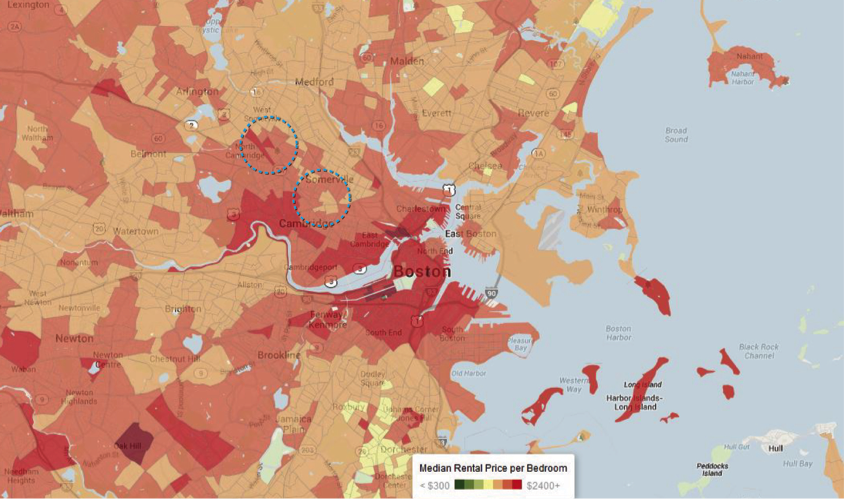
Davis Square and Inman Square are no bargain any more.

Schools
Lastly, all the kids in strollers will need a place to attend school someday. If only Somerville were that place. SchoolDigger.com<http://SchoolDigger.com> recently rated the city 299th out 325 school systems<http://www.schooldigger.com/go/MA/districtrank.aspx> state wide. For all the progress Mayor Joe Curtatone has made, he’s clearly focused on the early adopters and the hipness of the city, with the schools as a longer term project. It might be sensible, but he and the city are running out of time. The Wellesleys, Newtons and Miltons might lack hipsters or artists or gays but they have a leg up on schools, an advantage suburbia has always had over the urban core. Undoubtedly its schools will have to do better and they will as gentrification will lead to higher standards, be they in the retail, real estate or city services sectors.

Somerville finds itself (by definition a suburb, yet still a city) in an interesting position as the effects of hipness and gentrification point to seemingly distinct paths. One is like other hipster havens<http://www.forbes.com/sites/morganbrennan/2012/09/20/americas-hippest-hipster-neighborhoods/> in Brooklyn or Wicker Park – places that have retained a shade of the counterculture tendencies that define hipster identity. Two is like mature urban inner ring suburbs, Brookline and Cambridge being two local examples. The latter can claim to be cool but lack the authenticity of Somerville’s creative culture. The former over deliver on cool and trendiness and priceyness but because they are neighborhoods within New York and Chicago (or any large city) respectively, under deliver on the city services that suburbs provide. Whatever happens, the hipsters likely won’t be a permanent part of Somerville history as it’s usually the politicians or the wealthy elite of any given place that decide its fate. For now the trendy capital of Metro Boston can pat itself on its plaid-clad back, and keep its beanie cap-covered-head high. See you at Chipotle.

Andrew Zimmermann is an architect and urban designer with NBBJ<http://www.nbbj.com/>, a global architecture firm with a presence in Boston. He lives in Somerville’s Davis Square with his wife and occasionally writes about design, real estate or anything that he finds interesting on www.zimmswhim.com<http://www.zimmswhim.com/>.