Don’t just flip the classroom, flip the school day
By: Michael B. Horn
Oct 10, 2019
Flipping the classroom—in which students independently consume online lessons or lectures and then spend their time in the classroom focused on what we used to call homework—crashed on the scene eight years ago. But if Bob Harris, president of Edudexterity and currently working as the head of human resources for Pittsburgh’s school district, is to be believed, it isn’t enough.
It’s time to flip the high school day, he says, and he has plans for how to do it.
The basic idea is that almost all students would benefit from gaining a variety of real work experiences while in high school because they would gain a deeper appreciation for their potential directions in life; an understanding of their strengths, passions and purpose—a glaring gap in high schools that emerged in research for our new book Choosing College—and social capital in the form of mentors and potential professional connections outside of school and the circles of their family and friends, about which my colleague Julia Freeland Fisher has written extensively.
In Harris’s conception of the flipped school day, students would start their day at 9 a.m.—more in line with the research around when teenagers should wake up and start their days—by reporting to a workplace that could rotate every semester or year.
After working half a day, the students would then break for lunch and head to school to do their extracurricular activities and work on projects with their fellow students.
Finally, in the evenings, students would take their classes online from home when their parents are more likely to be at home—also more in line with research that suggests students tend to perform better in courses that meet later in the day. They wouldn’t have homework per se, as work would simply be woven into their online learning experiences.
One of Harris’s insights is that a big reason school exists as it does is that it plays an important custodial function in the lives of many families. For years, the only way to learn from a teacher was in a classroom.
But with the advent of online learning, students can theoretically learn anywhere, which means that you can change what you do during the times when it’s important to provide custodial care for students. All too often, students are already doing most of their learning late in the evening anyway. Rather than fight it, why not embrace it?
All too often, students are already doing most of their learning late in the evening anyway. Rather than fight it, why not embrace it?
CLICK TO TWEET
Plus, far fewer teenagers—roughly 20%—hold a job today compared to a generation ago when 40% did. Flipping the school day would rectify that challenge and fill the morning time in a productive fashion.
Doing so would also equip students with an understanding of how their learning connected to their potential careers after school, which, in the ideal, would help them build motivation for when and what they learn online—which itself could be far more tailored for their learning needs, both in terms of the choice of courses and in terms of the learning pace and path within the courses.
It would also seem to present an interesting solution to the return of people’s nostalgia for career and technical education. And by flipping the school day for all students, it could potentially avoid the historical perils of tracking students into academic versus career pathways in high school.
Flipping the school day for all students could potentially avoid the historical perils of tracking students into academic versus career pathways in high school.
Finally, flipping the school day could also greatly bolster the counseling function in high schools. Today counselors operate at a 491-to-1 student-to-counselor ratio in high schools, which means there is little time for meaningful advice for students. But by placing students into jobs in the community, schools could potentially leverage a far wider swath of their community’s resources to help counsel and guide students into the choices they make in their lives.
If no high school wants to go all-in on the experiment, then they could try it as a pilot for a segment of their students. In so doing, they could also use it to create more capacity in their school by changing when and how the building is utilized and providing more shifts for students so that the schools would be open for far longer, act more as community centers, and students could experience smaller class sizes with teachers.
Given all we know, flipping the school day seems like a worthwhile experiment to me.
Michael B. Horn
Michael is a co-founder and distinguished fellow at the Clayton Christensen Institute. He currently works as a principal consultant for Entangled Solutions.
Showing posts with label Competency Based Education. Show all posts
Showing posts with label Competency Based Education. Show all posts
Friday, October 11, 2019

Thursday, April 25, 2019
The challenges of changing to competency-based learning
As Michael Horn, recently wrote, "Fundamentally
the question comes down to this: Do we want our education system to be a
sorting system or a learning system?"
How well-intentioned education and business leaders, backed
by wealthy foundations and a success story from faraway Alaska, sold state
lawmakers on a largely untested theory of change
by KELLY FIELD April 19, 2019
Ragan Toppan, a junior at Deering High School, took part in
a walkout last fall to protest a change in the school’s grading policy. Kelly
Field, for The Hechinger Report
This past fall, Ragan Toppan, 16, walked out of her Algebra
II class at Deering High School to protest her school’s recent switch to
standards-based grading.
Toppan, a junior at the high school, was angry that the
administration hadn’t sought student input about the change, and worried that a
switch to a 1-4 grading system, with a 3 the highest possible grade on some
assignments, would hurt her chances of getting into a good college. On her
transcript, those 3s, which signify proficiency in a standard, would appear as
85s, or B’s.
“I shoot for A’s on all my work, but a lot of teachers don’t
give you an option to go ‘above and beyond’ ”
Her mother, a longtime English teacher at Deering, sees
things a little differently. Kathryn Toppan switched to a 1-4 scale even before
the administration required it, finding it “less arbitrary” than the
traditional 1-100. “It’s easier to communicate to students where they’re at and
what they need to do to improve,” she said.
She sympathizes with students, like her daughter, who have
seen their high school careers disrupted by change. But she believes there is
no other way. “Sometimes it doesn’t seem fair, but there’s sort of a greater
good,” she said.
Seven years after the state passed a law that required
Maine’s high schools to award diplomas on the basis of demonstrated
“proficiency” in eight key areas, and nine months after the legislature
repealed that mandate, the debate over proficiency-based diplomas continues to
divide districts, teachers and families here, even as the concept spreads to
other schools and states.
In a recent survey of the state’s superintendents conducted
by the University of Southern Maine, roughly a quarter of respondents said they
planned to stick with a proficiency-based diploma, even though the law no
longer requires it. Thirty-eight percent said they would likely return to
awarding diplomas based on the accumulation of credit hours. Another quarter
preferred “hybrid” approaches, and 11 percent said it was too soon to
speculate.
“No other state has embraced this model for all their school
systems. We’re not ready for this.”
Earle McCormick, a former teacher and state senator
The only thing most everyone agrees on is this: The rollout
of the 2012 law, LD 1422, was a disaster, plagued by insufficient funding and
inadequate guidance from the top. While the state’s Department of Education
cycled through commissioners (six in six years) superintendents struggled to
figure out the law, largely on their own.
The result today is a patchwork of local policies, with
pockets of proficiency-based grading surrounded by schools that have stuck with
traditional methods of evaluating students — or reverted to them recently.
Districts have spent thousands of dollars on consultants and software upgrades,
and the racial and socioeconomic achievement gaps that the law was supposed to
help eliminate remain largely unchanged.
Related: Documenting Maine’s failure to implement
proficiency-based education
Now, as a new governor and legislature grapple with these
gaps, many parents and educators are left asking: How did Maine get into this
mess?
To answer that question, The Hechinger Report combed through
grant databases, legislative records and lobbying disclosures, looking for the
forces and funding behind LD 1422. We spoke with more than two dozen lawmakers,
foundation heads, business leaders and educators about the bill.
The story that emerged is a complicated one, spanning more
than two decades and reaching across the country to a remote district in Alaska
that became a model for Maine.
At its heart, though, it’s a familiar tale in American
school reform — the story of how a small band of well-intentioned education and
business leaders, backed by wealthy foundations and armed with optimism and a
few early success stories, sold state lawmakers on a largely untested theory of
change.
Imported from Alaska
Proficiency-based education is a wonky term, but in essence
it means that students master certain skills before they move up a grade or
graduate. The amount of time they’ve spent in the classroom (“seat time”)
doesn’t matter, nor does the number of credits they’ve accumulated.
proficiency based learning
Deering High School, one of the largest in the state of
Maine, is in the midst of a controversial transition to proficiency-based
diplomas. Kelly Field, for The Hechinger Report
In theory, proficiency-based models let students learn at
their own pace, speeding up if they grasp a concept quickly, and getting extra
help if they struggle. In practice, though, it can take many different forms,
including independent study, learning communities and online programs. It
doesn’t always include changes to grading — and indeed, Maine’s law didn’t
require any.
To supporters like former state senator Brian Langley, a
longtime culinary arts instructor and the sponsor of the now-repealed LD 1422,
proficiency-based diplomas are a way to ensure that all kids graduate with the
skills they’ll need to succeed in a changing economy.
“It’s about equity,” he said. The law “was bringing a voice
to the kids who don’t have helicopter parents, so when they left high school,
their diplomas would mean something.”
Maine’s march toward a proficiency-law began in 1997, with
the adoption of the Maine Learning Results, which set statewide standards in
eight content areas. It accelerated a couple of years later, when the Bill
& Melinda Gates Foundation began pouring millions of dollars into high
school reform and the creation of small schools. (The Gates Foundation is among
the many funders of The Hechinger Report.)
In 2000, Tom Vander Ark, the first executive director of
Gates’ education program, heard about Chugach, a district in Alaska that had
seen dramatic gains in test scores after switching to a proficiency-based
model, and he decided to visit.
There, in tiny schools reachable only by plane, Vander Ark
spoke with students who “could tell you exactly what they were learning, why it
was important, and what they had to do to move to the next level in each
subject,” he said in an interview. Each student had a little bar chart on their
desk that tracked their progress toward mastery in each standard.
“I was fascinated by it,” he said. “I had never seen kids so
in charge of their learning.”
Related: What if personalized learning was less about me and
more about us?
When he returned to Seattle, Vander Ark gave the Alaska
Council of School Administrators $5 million to bring the Chugach district’s
model to six other Alaska districts.
The next year, Chugach, with its 214 students spread across
22,000 square miles of glaciers, mountains, islands and wilderness, won the
prestigious Malcolm Baldrige National Quality award. The federal award brought
national attention to the district, which created a nonprofit, the Re-Inventing
Schools Coalition, to take its approach nationwide. The group’s acronym, RISC,
was deliberate, according to a book by its creators, “Delivering on the
Promise.” Schools and districts that adopted the model “would take risks in
transitioning to a system fundamentally distinct from the one that was deeply
ingrained in U.S. culture.”
In 2003, the Gates Foundation gave RISC $5.8 million to train
additional Alaska school districts and to create a research and development
program.
“The mission was to hit the tipping point to transform the
education system,” said Richard DeLorenzo, the former superintendent who
created RISC. “That was my vision.”
$13 million in outside philanthropic funding supported two
Maine districts’ efforts to implement proficiency-based education
The first converts were Adams County School District 50, in
the Denver suburbs, and the Lindsay Unified School District, in California, he
recalls. Like the Chugach district, they had high percentages of low-income
students, though they were much larger districts than Chugach, with more than
10,000 and 4,000 students, respectively.
Meanwhile, in Maine, a handful of districts were
experimenting with similar methods. Among them were RSU 2, a far-flung district
in central Maine which includes the towns of Hallowell and Monmouth; MSAD 15, a
district midway between Portland and Lewiston; and RSU 20, which includes the
small coastal community of Searsport. Searsport had started transitioning to a
standards-based diploma in 2002, after receiving a share of a $10-million
school reform grant that Gates had made to the Sen. George J. Mitchell
Scholarship Research Institute, an organization that gives out scholarships to
Maine students.
In 2007, Maine’s then-commissioner, Susan Gendron, invited
DeLorenzo to speak at a summer conference for superintendents in Bar Harbor. At
the end of the conference, she took a survey: 80 percent of attendees said they
supported the RISC philosophy, but only a quarter said they were ready to make
the leap, she said in an interview.
To encourage them along, the state offered schools $50,000
grants to subsidize RISC training, Gendron recalled. DeLorenzo screened the
candidates, assessing their capacity for change, and six districts were
approved, among them the three districts mentioned above that had already begun
experimenting with the model.
When the state withdrew its financial support for the
training a year and a half in, citing budget shortfalls, the districts formed a
consortium to pool their resources: The Maine Cohort for Customized Learning.
One of the first things the new nonprofit did was hire Beatrice McGarvey, from
Marzano Research, a consulting organization that offers professional
development to schools across the country, to craft a common curriculum, said
Linda Laughlin, now the Maine group’s executive director.
At least one of the early pioneers, RSU 18, which includes
the small town of Oakland, has since backed away from a standards-based
diploma. But one district has been steadfast in its commitment, staying the course
through three superintendents: RSU 2.
A local success story
In a math classroom inside Monmouth Academy in the RSU 2
district, 20 students, ranging from freshmen to seniors, sat in clusters of
four, working independently on small dry erase boards. Some were still studying
geometry, others had advanced to Algebra II. One group was just starting on
probability.
proficiency based learning
Elizabeth Ross, a math teacher at Monmouth Academy, explains
a chart that shows which standards students have met. Kelly Field, for The
Hechinger Report
Elizabeth Ross, a ninth-year teacher in the district, buzzed
between them, stopping to show two juniors, Violette Beaulieu and Hannah
Levesque, how a parabola can dip from positive to negative.
When they understood the concept, Ross moved on, giving
another group a lesson in operations with square roots. Then she moved on
again.
After an hour of shuttling between students, Ross was sweaty
and flushed, the carton of yogurt on her desk only half eaten. It’s hard work differentiating
curriculum for so many students, but Ross believes it’s worth it.
“I feel like they learn more,” she said. “When I give them a
test, they have to know all of it” to earn a 3 and be deemed proficient. “Not
just 70 percent.”
On the wall, there was a chart with stickers showing which
standards students had met. Shading in the boxes indicated a higher level of
competence — half-shaded was a 3.5 and fully shaded was a 4. The students had
requested the shading, to show more nuance in the scores, Ross said.
Levesque, who wants to go to either St. Joseph’s or Thomas
College and become a realtor, strives for all 4s, often requesting extra work
to get to that level. But Beaulieu, who hopes to attend the University of Maine
Farmington and become a preschool teacher, said she’s content with a “solid 3.”
Both said they like the individualized instruction that they
get from teachers like Ross, and appreciate the opportunity to retake exams if
they have a bad day. They worry, though, how they’ll fare in college, where
professors are less forgiving, and there’s thousands of dollars in tuition at
stake.
“Here, if I get something wrong, I’ll be able to go back and
fix it. In college, you can’t,” said Beaulieu. “That kind of freaks me out.”
RSU 2 is often held up as a standards-based success story.
Nearly a decade in, the culture of competence is deeply ingrained in the
district; most of today’s high schoolers have never experienced anything
different.
Getting to this point wasn’t easy, though. When Hallowell
tried to extend proficiency-based education to its high school in 2008, parents
put up a fight, saying the change would make it harder for their children to
compete for scholarships and admission to selective schools, according to a
case study published by the state Department of Education.
The state ramps up
Meanwhile, the momentum — and the spending — for reform was
continuing to build. In 2009, Gates gave half a million to the Nellie Mae
Education Foundation, which describes itself as New England’s largest
education-focused philanthropy, to lead a four-state effort to remake the
region’s schools. (Nellie Mae is among the many funders of The Hechinger
Report.) Nellie Mae passed on the money to the Portland-based Great Schools
Partnership, which used it to coordinate The New England Secondary School
Consortium, a coalition advocating for proficiency-based diplomas, among other
things.
The following year, Gates gave Nellie Mae an additional
$1.75 million to identify and fund “proficiency-based pathways.” Some of that
money trickled down to MSAD 15 and the Casco Bay High School for Expeditionary
Learning, in Portland, which had been created five years earlier using a grant
from The Gates Foundation. At Casco Bay, the money would be used to create a
“roadmap” for other districts and Portland’s two other high schools to follow,
according to a 2012 report on the initiative.
Nellie Mae, which had $430 million in assets at the end of
2009, began investing its own money in Maine, too. In 2010, it gave $200,000
each to Portland and two other districts to develop plans for “district level
system change” focused on “student-centered approaches,” including
proficiency-based education.
At the end of the following year, it awarded organizations
in Portland and Sanford nearly $9 million to implement their plans. To build
public support for the changes, the foundation also gave smaller grants to
youth and immigrant advocacy groups in the districts.
The foundation ultimately gave a combined $13 million to the
two districts, with roughly two-thirds of it going to Portland, according to a
Nellie Mae spokesperson.
In its application for its 2011 grant, Portland pledged to
move the entire district to a proficiency-based diploma. When the grants were
announced, Nicholas Donohue, the foundation’s president, said the districts
were chosen because they were already “most aligned with our theory of change.”
But some Portland parents were wary of the award. Anna Collins,
a Portland mother and attorney, said she saw the grants as an attempt to build
support for LD 1422, which had just been approved by the state legislature’s
education committee and would soon be debated by the whole legislature.
“They can say ‘We’ve got some of the biggest districts in
the state on board, you have to pass this,’” she told the Bangor Daily News at
the time.
Nellie Mae was supporting the proposed law. A few months
before it made the grants to Portland and Sanford, the foundation gave the
first of three grants to the Maine Department of Education to create an online
Center for Best Practice, with case studies of districts that had embraced
proficiency-based learning.
That same month, it awarded $50,000 to the Maine Coalition
for Excellence in Education, a business group now part of Educate Maine, to
support its “political/legislative work.” The coalition, which had drafted an
omnibus education reform bill that was ultimately whittled down to LD 1422,
used the funds to host a retreat for members of the education committee shortly
before the legislature voted on the bill. The lawmakers visited a
proficiency-based school in Oakland and attended a policy forum in Freeport.
Just before the vote on LD 1422 in early April 2012, Educate
Maine and Great Schools Partnership circulated a letter to committee members
with the signatures of nearly 50 principals and superintendents who supported
the bill.
Ed Cervone, the executive director of Educate Maine, said LD
1422 was an attempt to bring accountability to the Maine Learning Results,
which the state had passed 15 years earlier, but never adequately enforced.
“This wasn’t some radical new pathway,” he said. “We were
looking at finishing the pathway put off by governors prior.”
Guinea Pigs
When the legislature debated the bill, lawmakers who
represented communities in RSU 2 spoke against it, citing complaints they’d
received from parents and students in their district. They urged lawmakers to
slow down and let districts decide whether to implement proficiency-based
diplomas on their own.
“No other state has embraced this model for all their school
systems,” warned Sen. Earle McCormick, a former teacher who represented part of
RSU 2. “We’re not ready for this.”
The heavy involvement of unelected, out-of-state foundations
in advancing proficiency-based diplomas stoked suspicion and resentment among
some Maine parents and teachers. They created a Facebook Group called “Mainers
Concerned About Proficiency Based Learning,” where they shared lobbying
reports, grant details and consulting contracts, and swapped horror stories and
conspiracy theories. The group remains active today, with 1,500 members.
“Have you found a grassroots movement pushing for this?”
Ericka Lee-Winship, a teacher at Portland High School
“We are guinea pigs for a new, experimental method of
teaching and learning that has been designed to benefit content providers
rather than students,” wrote Emily Talmage, a fourth-grade teacher in Lewiston
in a 2015 post detailing spending by Nellie Mae.
That view is shared by policymakers like Rep. Heidi Sampson,
who led the push to overturn the law. In an interview, she said the law was
created to “pad the wallets” of consultants like Great Schools Partnership,
which offers coaching to districts.
Great Schools Partnership, which charges schools and
districts between $24,000 and $84,000 for its services (depending on the number
of coaching days), did see an uptick in contracts after the mandate passed,
from 18 to 25, and a decline back to 18 after the law was repealed, according
to data provide by Ian Bassingthwaighte, a spokesman. It also won a $200,000
contract from the state to create free standards-based tools for schools. But
the law was hardly a bonanza for the nonprofit, and Bassingthwaighte said it’s
not in it for the money.
“We are former teachers, principals and superintendents who
are dedicated to our mission of ensuring high quality learning for each
student,” he said.
(Great Schools has received continued support from Nellie
Mae; the foundation gave it several million dollars to administer the New
England Secondary School Consortium and to run a program aimed at building
“public understanding and demand” for reform across the region, including in
three Maine communities.)
Charlie Toulmin, Nellie Mae’s policy director, insists his
foundation wasn’t the driving force behind the law.
“They were already walking down this path, and they and us
sort of found a match in our interests,” he said.
Staying the course in Portland
Portland’s district leadership has said it plans “to stay
the course with its transition to a proficiency-based diploma,” regardless of
changes in the law.
proficiency based learning
The entrance to Portland’s Deering High School, the most
diverse high school north of Boston. Nearly half the enrollees are students of
color. Kelly Field, for The Hechinger Report
In the city’s two traditional high schools — Deering and
Portland High School — classes look, and sound, much as they did prior to
2012.. The only signs that things have changed are posters that hang in some
classrooms, enumerating the standards and proficiency levels.
Most of the ongoing change is happening behind the scenes,
in departmental meetings where teachers hash out graduation requirements, and
in online gradebooks, where teachers spend hours assigning standards to
assignments, and rating students on levels of proficiency. It’s a ton of data
entry, but none of it has appeared on students’ report cards, which still
include traditional numerical grades.
That frustrates teachers like Ericka Lee-Winship, who would
“much rather spend time planning exciting lessons than sitting at my computer
clicking buttons.”
Lee-Winship, who has taught social studies at Portland High
School for 21 years, thinks the Great Schools Partnership coaches her school
has hired are smart and mean well, but are out of touch with the realities of
the profession.
“They want teachers to think big picture, but every day I’m
expected to manage the details,” she said. “When I go home, I have a huge bag
of homework to grade. I’m not sitting around pondering the big picture
questions.”
She believes the state’s shift to proficiency-based diplomas
was driven “100 percent” by foundations and interest groups.
“Have you found a grassroots movement pushing for this?” she
asked.
Beth Arsenault, who has taught in Portland High School since
1996, has practiced many of the habits of proficiency-based learning for years
— letting students retake tests and keeping her grade book open, for example.
In her alternative education classes for at-risk students, the mantra is
“you’re not passing yet.”
So she’s not philosophically opposed to proficiency-based
education; she just doesn’t like it being imposed on teachers by outsiders.
And, like Lee-Winship, she finds the data entry meaningless.
“Trust me, professionally, that I’m teaching to the
standard,” she said.
With neighboring districts backing away from
proficiency-based diplomas — including those centered in Scarborough and South
Portland — many teachers here hope theirs will be the next to fall.
Ragan Toppan, now 17, is among the students who do, too. She
was pleased in January when Deering took a small step backward, giving teachers
the option of grading using either a 1-4 or 60-100 scale. But the compromise
has the potential to complicate transcripts, and thus the college application
process, for students like her: “We can’t forget that kids are planning for
their futures. This may be a test run for the administration, but these are
real lives, real students.”
“I shoot for A’s on all my work, but a lot of teachers don’t
give you an option to go ‘above and beyond.’ An 85 is not going to cut it for
college.”
Ragan Toppan, a junior at Deering High School
Her mom, Kathryn, remains committed to the 1-4 grading
system. But even she says it would be “premature” to switch to a
proficiency-based diploma before ironing out the kinks around remediation and
grading.
In the meantime, Deering’s teachers have agreed to award up
to a 4 on all assignments that use the 1-4 scale, according to Principal Gregg
Palmer. He said he didn’t think many teachers limited students to 3s before,
but “I can’t say it never happened.”
And what about the Alaska-based group that brought its model
to Maine? DeLorenzo, who created RISC, lost his passion for the business, and
was running a fly-fishing business when he got a call from a Russian friend who
asked him to come create schools there. They’re up to five now. He believes the
“hierarchal, compliance-driven culture” of Russia is more conducive to system
change than the U.S.’s locally controlled one. “I never had the leverage to
flip American schools, to get CEOs behind me. That’s why I’m in Russia,” he
said.
RISC, meantime, was acquired by Marzano Research and is no
longer offering trainings. Marzano, which helped Maine’s pioneers in
proficiency develop their curriculum, is creating a series of proficiency-based
student “academies” with help from RSU 2 superintendent Bill Zima, who is
leaving at the end of the school year to join the company. So far, none of the
academies are in Maine.
Chugach has stuck with its proficiency-based diploma, but
test scores have dropped, from the top quartile of the state to roughly the
middle, according to current superintendent Mike Hanley. Nearly all of the
schools in Alaska that copied its model have since abandoned it. Bob Crumley,
the superintendent who put it in place, thinks they got complacent.
“Over time, it didn’t seem as urgent,” he said. “The initial
adrenalin and drive kind of waned.”
Nellie Mae, meanwhile, is re-thinking its grant-making
strategy, acknowledging that some of its investments in “student-centered
learning” haven’t had as big an impact on low-income students and communities
of color as the foundation had hoped. Going forward, the foundation will “put
much more attention on racial equity” and be more open to grant proposals that
don’t involve student-centered practices, Nellie Mae’s Toulmin said.
In RSU 2, there’s less pushback to proficiency than their
used to be. But some parents and teachers still worry about the lack of
consequences for slacking. Deadlines here are flexible, and students know they
can retake tests if they don’t feel like studying one night.
“There’s no motivation because there’s no deadlines,” said
Jennifer Heidrich, the mother of a Monmouth middle schooler who teaches in
another district. “His attitude is he shouldn’t have to do work outside school.
Coming from a teacher’s kid — you can imagine the fights we get into.”
School leaders acknowledge this challenge, and have begun
requiring students to rate their “habits of work,” each Friday. Teachers review
the scores and can change them if they disagree. If a student’s “habits of
work” are poor, they can lose junior or senior privileges. But there are still
no consequences for underclassmen, and the score doesn’t affect a student’s
grade.
“It doesn’t have teeth,” said Christine Arsenault, a
longtime English teacher and supporter of proficiency-based learning. “That’s
the biggest downfall.”
Tuesday, September 19, 2017
Personalized, Competency-Based
“Personalized, Competency-Based.” These three words (maybe two words, depending on how you count) most succinctly define an approach to education that puts each learner at the center of the learning ecosystem. An alternative term often used for this movement, “blended learning,” while it has advantages, evoking nuance and hybrid approach, instead of false dichotomies (such as digital and physical, testing and anti-testing, whole language and phonics, new math and old), loses the imperative to move past antiquated approaches to teaching and learning, built from 18th century Prussian model, and brought to scale under Horace Mann in America as universal public education.
Although this assembly line model for education made universal public education possible, it no longer serves our diverse population to prepare them for the careers of the future. Since the 90s, all 50 states have worked towards clarifying academic standards in core academic areas that are aligned with preparation for college and careers. Whether based on Common Core, or not, each state has published a taxonomy of 50-100 competency statements for each grade and subject. In an effort to ensure all young people stay on track to these standards, ability-grouped tracking has lost favor and been replaced by a commitment to all kids. While an understandable reaction to the demonstrated stigma of hard tracking, this approach has resulted in classrooms that by middle grades where a math teacher may be challenged by students whose math abilities may range from one or more grade behind to one or more grade ahead, therefore, spanning perhaps 600 skill differential between highest and lowest performing students. From this perspective, “teaching to the middle,” makes little sense.
Instead, as Sal Kahn says, we can “flip the classroom,” and provide anytime, any place, any pace access to learning experiences that target the “zone of proximal learning” for each student. Instead of moving with the herd of learners by age and grade, each learner can “move on when ready” to the content and depth optimized to their needs. In these new learning environments, teachers become elevated from that of lab technician, working nights and weekends in a near futile attempt to provide timely feedback, to learning doctors, synthesizing self-grading learning materials into personalized, constructive feedback.
We stand at the brink of a new era in education; one in which learners demonstrate skills in diverse settings both within and outside traditional schools. For less than 1% of the average US K12 budget, every student in America can have access to a learning device like a Chromebook. New skills, like computational thinking, add to the foundational skills of numeracy and literacy that are rapidly becoming indispensable for participating in the new economy. Open source, not-for-profit, and philanthropic learning tool providers like EnageNY, Open Up, Kahn Academy, Code.org, EdX are providing a rapidly growing set of high-quality free resources. While many public schools remain on the treadmill of letter grades on transcripts targeting college admissions, elite independent schools across the nation are shifting the conversation by coming together through the Mastery Transcript Consortium to replace letter grades on transcripts within five years. Although the federal government is no longer providing meaningful leadership, US global tech titans Apple through XQ Super Schools and FaceBook through the Chan Zuckerberg Initiative have joined foundations funded by Gates, Dell, and Hewlett to help spur the innovation needed for these changes to occur.
What does it look like? A classroom that has been “flipped” provides learners with online videos and reading material they can watch and read at their own pace, and often in their own language, in their home or any other informal learning environment. When in school, in the presence of a trained educator, learners typically benefit most from learning while doing, practicing skills like writing and problem solving under the supervision and support of their teacher. The classroom is flipped because the type of active learning traditionally assigned to homework is done in the classroom and the more passive reading and viewing are done outside of class. In this environment, learners are freer to move at their own pace, practicing each skill until mastery is evidenced and then moving on instead of waiting for classmates. Taken to its logical extreme, the concepts of “class” and “course” break down to learning modules that group students more dynamically and avoid the negative consequences of rigid tracking.
What should states do to support personalized, competency-based learning? The evolution of the learning ecosystem occurs at all levels, individual, class, school, district, and state. States have a critical role, establishing the conditions to support local innovation. Most importantly, as I described in my prior post, state-supported summative assessments must evolve to take less instructional time and separate faster accountability instruments from embedded diagnostic tools. In addition to that, states need to support technology and policies that enable learners to pursue pathways to future careers through an open system of micro-credential badges.
States like Georgia are leading the charge. Since 2015, under the leadership of State Superintendent of Schools, Richard Woods, the Georgia Department of Education has been committed to leading the Nation in use of open standards, open source technology, open education resources, and free educational resources to create personalized learning pathways for the next generation of Georgia learners. GA DOE will begin this work with a focus on computer science and computational thinking and will expand to all other subjects. They are developing partnerships from the National Science Foundation, Department of Defense, and leading education foundations to establish a micro-credential pathway from K-12 to military enlistment/training, employment/occupational licenses, and postsecondary learning. When complete, Georgia will become the first state in the nation to implement scalable policies to support personalized, competency-based learning.
Thursday, January 26, 2017
Free Computer Science University
Can 42 US, a free coding school run by a French billionaire, actually work?
by Chris Schodt/Edited by Jennifer Hahn.
And yet, here they sit, just 7.6 miles directly across the Dumbarton Bridge from Facebook headquarters in Menlo Park, dreaming of joining Silicon Valley’s legions of programmers. Each day, the students get new programming assignments, but there are no teachers. There is a help desk, or rather a “help” desk—which really, really doesn’t want students to ask for guidance—all in the name of “peer-to-peer learning.”
Cyrus Farivar
Welcome to 42 US, a free (as in beer) coding school, which opened just last month. Even the optional dorms are free. (Good news: laundry is also free! Bad news: you have to pay the dorm $75 a week if you want two meals a day.) Admittedly, it sounds totally crazy.
By comparison, programming boot camps have become big business across the United States. Recent research from Course Report shows that nearly 18,000 students nationwide pay an average annual tuition of more than $11,400, which results in annual revenue of nearly $200 million industry-wide.
But Xavier Niel, the billionaire founder of Free, France’s second-largest ISP, wants none of that.
The first 42—and yes, it’s named after the answer to life, the universe, and everything—opened in Paris in 2013. That location has more charm to it, what with its roof hot tub and wine cellar.
Despite being Silicon Valley-adjacent and down the road from an historic local farm, 42 US is actually in a former DeVry University campus that Niel bought in February 2016 from that for-profit trade school. Driving up to the building feels like going to a boring office park that could be in Anytown, USA. Immediately outside is a largely empty parking lot.
When Ars arrived earlier this month, it wasn’t even obvious at first if we were in the right place. We couldn’t see any “42 US” markings anywhere. The first person we encountered was a DeVry employee, who helpfully walked us over to 42’s section of the building. There, we found a Frenchman seated at a computer in a room that was entirely black. It looked like a small high school theater.
Eventually we were led to Brittany Bir, the school’s chief operating officer. She tried to answer our most fundamental question: why offer a free coding school?
“I do know that what [Niel] has been very interested in doing is to fill this gap that we have with Web developers to get projects to advance so that we can continue to evolve as a society and a community together,” she said.
“If we put up barriers to education with money or with backgrounds, that means there are innovative talents and individuals that are not able to have access to education. So the idea behind 42 is to create an opportunity where individuals from all different kinds of backgrounds, all different kinds of financial backgrounds, can come and have access to this kind of education so that then we can have new kinds of ideas. Because in order to innovate, you need to have new people who think differently.”
For now, the school clearly needs to do much more outreach, particularly to women: when we visited, 81 percent of the students were men.
“We’re only limited by the amount of women that want to apply to the program,” she said. “For us, we’re more than willing to take in more women, but more need to apply.”
Jump in, the water's fine
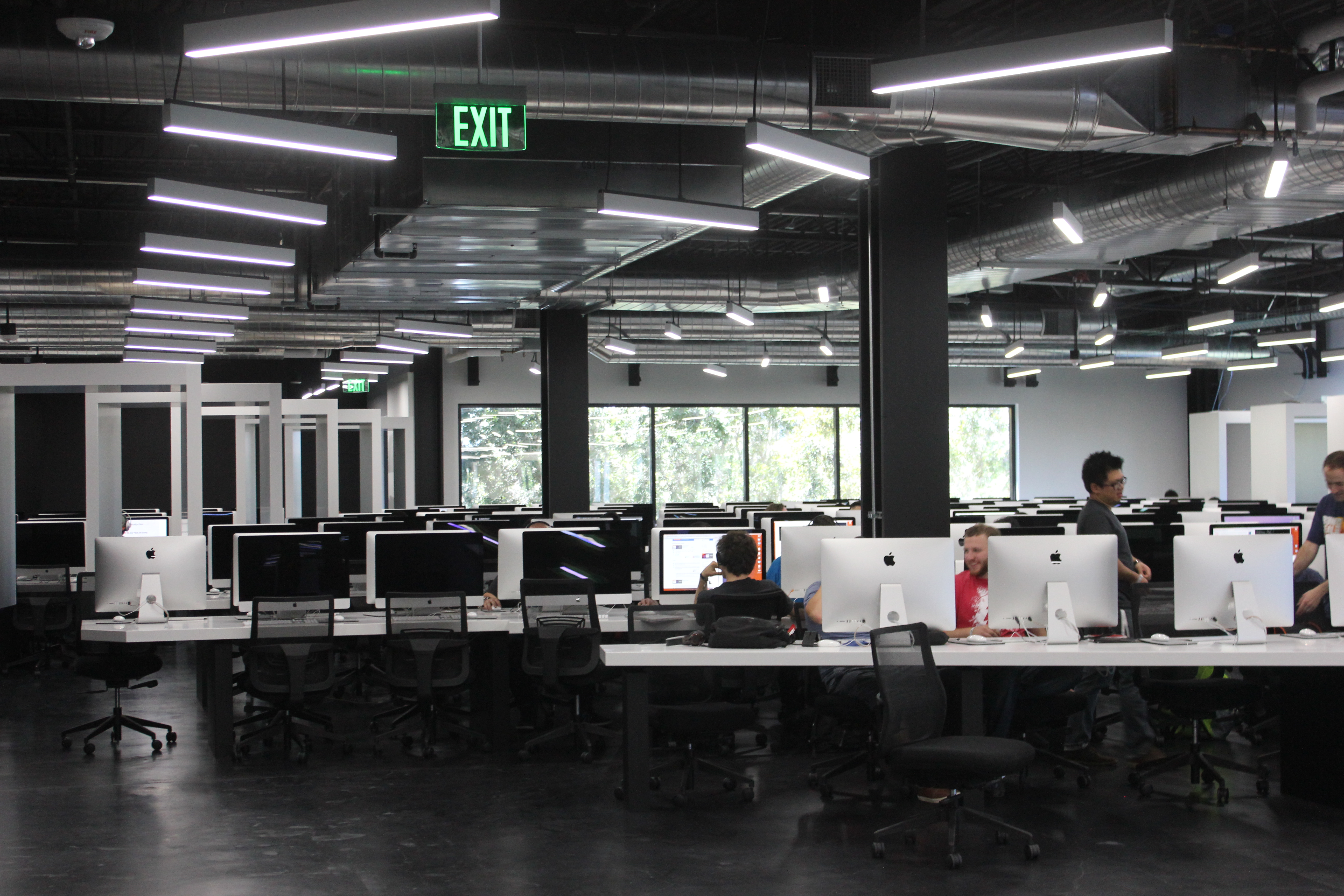
Cyrus Farivar
“Rather than going to a class with a professor and sitting and listening to lectures, this simulates what you would be doing in real life when you leave 42,” Bir said as she walked us through the space.
The school recruits online and has done well through word of mouth. We saw students from South Korea and Israel, as well as many Americans. Because 42 isn’t a bona fide licensed university, it can’t help with student visas. Students must already have legal status in the US in order to be accepted.
Bir explained how the 18- to 30-year-old students take an online logic test to see if they have the general aptitude and temperament for 42. If they do they are accepted into its “piscine,” the French word for swimming pool, meant to connote the school's “sink or swim” ethos. Students need not provide transcripts, personal essays, or anything else.
The piscine is 42’s month-long crash-course in programming, starting with learning C from scratch. Students spend 12 or more hours per day, six to seven days per week. If they do well, students are invited back to a three- to five-year program with increasing levels of specialty. The school expects many students to drop out, either because they can’t hack it or, ideally, because they get a job. Case in point: the piscine we saw started off with 250 students, but when we visited during the third week, 75 students had dropped out. (The next piscine, which began on August 8, welcomed 500 students, with plans to expand to 2,048 students.)
Bir herself went through the school’s program in Paris. When she started out, she had a degree in Spanish and no programming experience at all. Years ago, Bir left the US to pursue graduate work in Europe, where it would less expensive. She got a master’s degree and taught English at a computer science school before getting connected with 42. While in France, she met her husband, and she was eventually asked to help run 42 US. For now, she and her husband live in the dorms amongst the students.
“It’s kind of a blast from the past,” she said. “It’s reminding me of my days from college.”
A gentle push
Beginner students get lessons in re-coding some of the basic functions in the C library. But how do students know if they’re on the right track?
“In the end they correct each other,” Bir explained. “We have a program which will randomly select five members of our community, who will then be assigned to go correct.”
Students are required to do all work onsite. The school evaluates based on their attendance as well as their ability to grasp the relevant concepts and move forward at 42’s demanding pace.
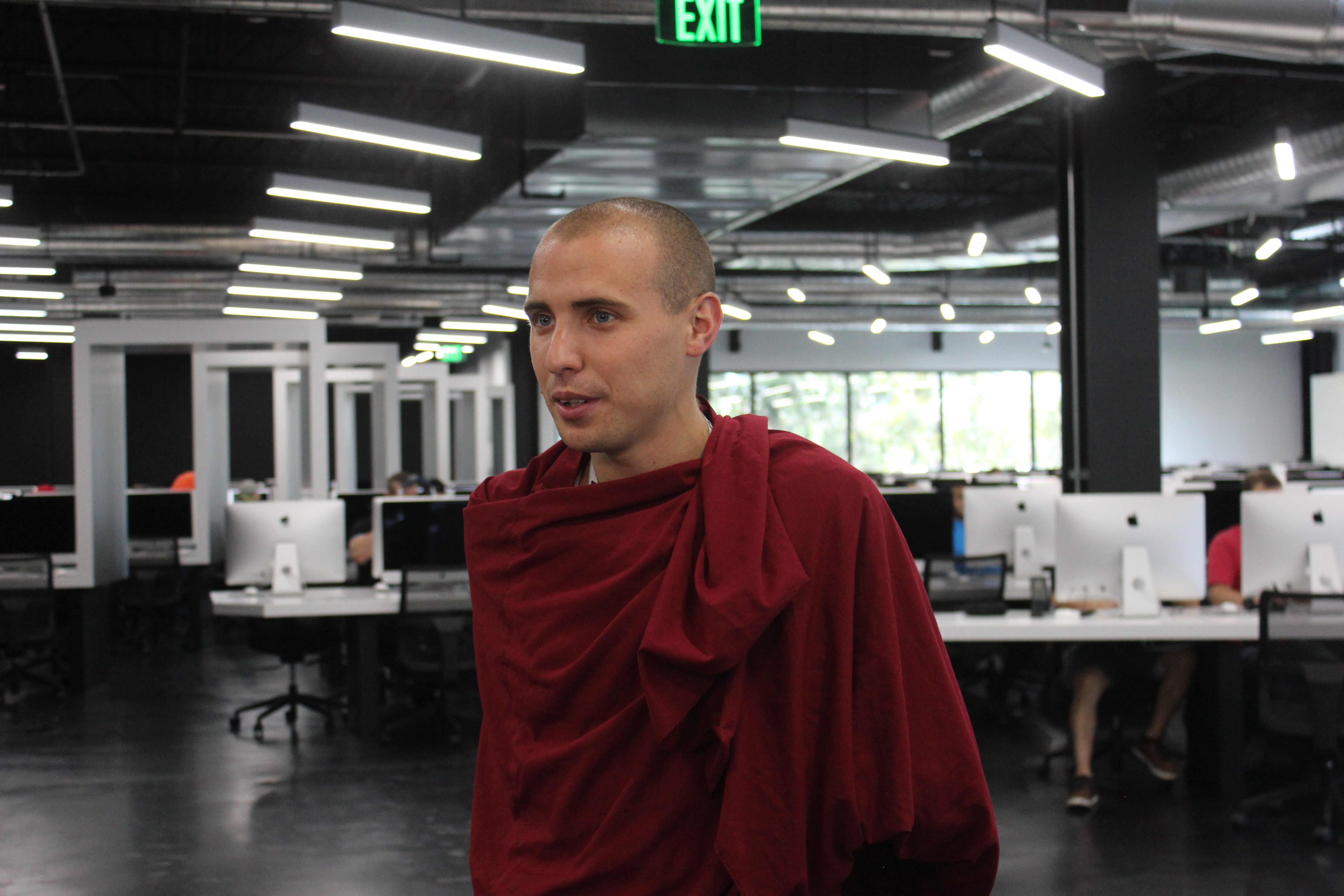
Enlarge / Lou Guenier is the pedagogical director at 42 US.
Cyrus Farivar
“We make sure they have enough projects to work on,” Lou Guenier, the pedagogical director, told Ars. “During the piscine, if they can finish every exercise of every day, that’s not a good thing.”
He said he’s been impressed by this round of students.
“They have more to lose than in France,” he added. “Because in France, we have free education, free universities. They don’t. Many students gave up two or three jobs just to do the piscine. So they are way more motivated, and I think in America they have the culture where you have to fight for something.”
From one boot camp to the next
One of Guenier’s students and Bir’s dorm-mates is David Lee, a dedicated 24-year-old from Cherry Hill, New Jersey. He came to 42 straight from serving five years in the US Army, most recently as a medic in Qatar. He said that he hasn’t seen anything crazy happening late at night in the dorms.
“Usually most people are coming back, either dead tired or trying to do their laundry,” he said. “It’s very quiet.”
Lee said that he has been learning a lot and would love to join a tech company. But that seems years away for now.
“Before this I had no programming experience, none whatsoever,” he said. “Initially it was really hard. Being able to explain what a type is, finding out how to read a function. Here they basically give you everything you need and [say] watch these videos and go figure it out.”

Enlarge / Hope Czuba, when not programming, is a fire performer.
Cyrus Farivar
“The expectations are too high,” she said. “It’s supposed to simulate a real-life work environment where your employer is asking too much of you, and you have to learn to be balanced in yourself.”
“I see tech as this really beautiful thing that is at the forefront of every revolutionary industry,” she said. “I’m not really sure how I’m going to help the world, but I would like to be able to help a lot of people all at once.”
Listing image by Cyrus Farivar
Monday, October 10, 2016
Jeff Sacks - Smart machines and the future of jobs
Smart machines
and the future of jobs
By Jeffrey D. Sachs
Since the early 1800s, several waves of technological change have transformed how we work and live. Each new technological marvel — the steam engine, railroad, ocean steamship, telegraph, harvester, automobile, radio, airplane, TV, computer, satellite, mobile phone, and now the Internet — has changed our home lives, communities, workplaces, schools, and leisure time. For two centuries we’ve asked whether ever-more-powerful machines would free us from drudgery or would instead enslave us.
The question is becoming urgent. IBM’s Deep Blue and other chess-playing computers now routinely beat the world’s chess champions. Google’s DeepMind defeated the European Go champion late last year. IBM’s Watson has gone from becoming the world’s “Jeopardy’’ champion to becoming an expert medical diagnostician. Self-driving cars on the streets of Pittsburgh are on the verge of displacing Uber drivers. And Baxter, the industrial robot, is carrying out an expanding range of assembly-line and warehouse operations. Will the coming generations of smart machines deliver us leisure and well-being or joblessness and falling wages?
The answer to this question is not simple. There is neither a consensus nor deep understanding of the future of jobs in an economy increasingly built on smart machines. The machines have gotten much smarter so fast that their implications for the future of work, home life, schooling, and leisure are a matter of open speculation.
We need to pursue policies so that the coming generation of smart machines works for us, and our well-being, rather than humanity working for the machines and the few who control their operating systems.
In a way, the economic effects of smarter machines are akin to the economic effects of international trade. Trade expands the nation’s economic pie but also changes how the pie is divided. Smart machines do the same. In the past, smarter machines have expanded the economic pie and shifted jobs and earnings away from low-skilled workers to high-skilled workers. In the future, robots and artificial intelligence are likely to shift national income from all types of workers toward capitalists and from the young to the old.
CONSIDER ENGLAND’S Industrial Revolution in the first part of the 19th century, when James Watt’s steam engine, the mechanization of textile production, and the railroad created the first industrial society. No doubt the economic pie expanded remarkably. England’s national income roughly doubled from 1820 to 1860. Yet traditional weavers were thrown out of their jobs; the Luddites, an early movement of English workers, tried to smash the machines that were impoverishing them; and poet William Blake wrote of the “dark Satanic mills’’ of the new industrial society. An enlarging economic pie, yes; a new prosperity shared by all, decidedly not.
Looking back at two centuries of more and more powerful machines (and the accompanying technologies and systems to operate them), we can see one overarching truth: Technological advances made the society much richer but also continually reshuffled the winners and losers. Similarly, one overarching pattern was repeatedly replayed. The march of technology has favored those with more education and training. Smart machines require well-trained specialists to operate them. An expanded economic pie favors those with managerial and professional skills who can navigate the complexities of finance, administration, management, and technological systems.
Overall, better machines caused national income to soar and the man-hours spent in hard physical labor to decline markedly. Seventy-hour workweeks in 1870 have become 35-hour workweeks today. An average of around six years of schooling has become an average of 17 years. With increasing longevity, most workers can now look forward to a decade or more of retirement years, an idea simply unimaginable in the late 19th century. It’s amazing to reflect that for Americans 15 years and over, the average time at work each day is now just 3 hours 11 minutes. Those at work average 7 hours and 34 minutes, but only 42.1 percent of Americans 15 and over are at work on an average day. The rest of the time, other than sleep and personal care, is taken up with schooling, retirement, caring for children, leisure and sports, shopping, and household activities.
Smart machines in the 19th century provided massive power (the steam engine), transport (rail, steamships, automobiles), information (telegraph), and material transformation (steel and textile mills), and also, crucially, a more and more powerful substitute for human brawn – that is, backbreaking physical labor — on the farm and in the mines. Seed drills, cotton gins, threshers, reapers, combined harvesters, and by the early 20th century, tractors, not only opened up vast new farmlands but also replaced millions of farm workers by machines. Mechanical cotton pickers in the early decades of the 20th century displaced millions of African-American sharecroppers on Southern farms and contributed to the great African-American migration to northern cities.
Hard physical labor declined as machines did more and more of this work; but so too did jobs and earnings for lower-skilled workers. Those lucky to get an education could obtain the higher skills needed for the new jobs. Those who could not suffered stagnant or falling wages and a further loss of social status. In the past two decades, more and more low-skilled men have simply dropped out of the labor force entirely.
The most important policy response is to ensure that students stay in school long enough to achieve the skills they need for the new and better jobs. As long as the national supply of skilled workers roughly keeps pace with the rising demand for skilled workers, while the supply of low-skilled workers declines in line with the decline in the numbers of low-skilled jobs, the gap in earnings between high- and low-skilled workers remains relatively stable. In this way, the rising school attainments of Americans during the 20th century roughly maintained a balance with the shift from low-skilled work to high-skilled work.
Yet after around 1980, the earnings of highly educated workers (notably, those with bachelor’s degrees and higher) increased sharply relative to less-educated workers (those with high-school diplomas or less). Greater international trade and offshoring probably had a role in this, and so did technology, with smarter machines replacing high-school-educated workers in a widening range of manual and repetitive tasks. The shift of the labor force toward higher-skilled workers wasn’t fast enough in recent decades. Many American lower-skilled workers have been hit hard by lost jobs and falling wages.
YET TODAY’S smart machines now are not just replacing brawn but also brains. The futurist Ray Kurzweil and others have popularized the term “singularity’’ to mean a time in the near future when machines are simply better than humans at just about everything: moving, assembling, driving, writing, calculating, war-making, teaching (yikes!), and the rest.
Several recent studies, including at Oxford University and McKinsey, have tried to estimate the share of jobs that are likely to be up for grabs by smart machines in the next 20 or so years. Each occupation is analyzed for the kinds of tasks needed. Are they highly repetitive or highly context-specific? Do they require highly specialized mechanical skills, a high degree of interaction with others, or a high measure of emotional empathy? And so on. From this categorization of job tasks, the researchers estimate the share of jobs that can be substituted by robots and artificial intelligence systems. Their answer: Roughly half of today’s jobs are susceptible to at least some kinds of replacement by smart machines.
The implications are a bit tricky. On the one hand, smarter machines mean more economic output and, in principle, a larger economic pie to share among the American people. Investing in machines, or in the companies that produce the smart systems that run them, would seem to offer high returns; capital owners would be very likely to benefit. On the other hand, smarter machines could mean a decline in the demand for workers. Young people with labor to sell but little wealth to invest could find themselves on the short end of the economic stick, with lower wages and no grand prospect of benefiting from the higher returns to capital. Older and richer Americans would tend to benefit, younger and poorer Americans would tend to fall behind.
This would not be the end of the story, however. If today’s young people find themselves without jobs, they not only will be poorer, but will also save less as a result of shrunken incomes. Yes, the smarter machines will offer a higher return to saving, but the supply of national saving will shrink. A careful theoretical analysis reveals a stark truth: Smart machines could actually set in motion a downward spiral, wherein today’s young workers can’t find decent jobs, and thereby cut back on their saving, which in turn leaves the following generation of young workers even worse off.
This is indeed a frightening vision. And yet the same analysis suggests a way out. If the rich capital owners transfer some of their windfall profits to the struggling young workers, then both the old rich and the young poor would be better off with the smart machines than without them. In effect, the rich older shareholders would compensate the poor younger workers in order to offset the fall in wages.
There are two ways this “offset’’ could happen. Within families, parents could transfer some of their increased wealth to their children; but alas, that is a solution that is likely to be relevant mainly for richer households.
For the non-rich, the real solution could and should be achieved through fiscal policy. Rich older shareholders should be taxed in order to make transfer payments to the poorer, young workers.
Such transfer payments could be carried out in many ways: a cut in payroll taxes; tuition-free higher education; an expansion of the Earned Income Tax Credit (EITC) for low-wage workers; or a “reverse’’ Social Security system with payments from the old to the young. One policy that has been suggested is a capital grant to every newborn, financed by a wealth tax. In essence, each newborn would receive a robot (or financial claim to one) at birth.
THE NEW AGE of smart machines has already seen a shift in national income away from wages and toward profits. In automobile manufacturing, for example, where robots have already displaced many assembly-line workers, the share of wage compensation in the industry’s value-added has tumbled from 57 percent in 1997 to 47 percent in 2014. For the economy as a whole, a recent study reports a decline in the labor share of national income from around 68 percent in 1947 to 60 percent in 2013. The shift toward capital income seems to be well underway, and would seem to be a key factor in America’s sharply higher inequality of income. As machines become even smarter in future years, the economy-wide shift from wage income to profit income is likely to continue.
In addition to income redistribution from capital owners to workers (and from old to young) there are three other steps we should plan to take.
First, as old jobs disappear and new ones are created, we should emulate Germany’s successful apprenticeship programs, which train young workers in the skills needed in the economy. The President’s Council of Economic Advisers has rightly emphasized the need for scaling up this kind of active training.
Second, we should prepare for a workforce in which workers will change jobs with much greater frequency than in the past. In an age of disruptive technology, we should plan for disruption. Changing jobs should be regarded as normal; training and skill upgrading should be life long, and health care and other benefits should follow workers, not jobs.
Third, and finally, let us remember that ever-smarter machines could enable us to enjoy much more leisure time, and more hours of the day at valuable but nonremunerated activities and volunteer work.
Suppose that singularity indeed arrives, so that robots and expert systems really do perform all the unpleasant and humdrum work of the economy. As long as fiscal policies ensure that everybody, young and old, can share in the bounty, the results could be a 21st-century society in which we have much more time — and take more time — to learn, study, create, innovate, and enjoy and protect nature and each other.
Jeffrey D. Sachs is University Professor and Director of the Center for Sustainable Development at Columbia University, and author of “The Age of Sustainable Development.’’
Tuesday, July 5, 2016

Subscribe to:
Posts (Atom)