Featured Post

Fix, Don’t Discard MCAS/PARCC

This fall I had one on one conversations with many of our state's leaders and experts on the misplaced opposition to testing in gen...

Showing posts with label Philosophy. Show all posts

Wednesday, December 22, 2021

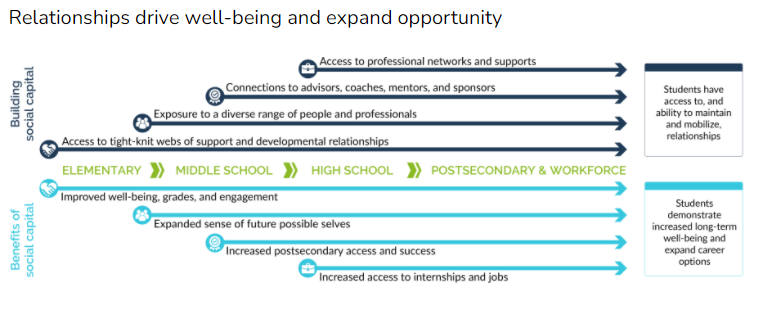
It matters who they know, not just what they know.


https://www.christenseninstitute.org/blog/how-an-asset-based-approach-to-building-students-networks-can-expand-their-opportunities/?utm_source=Ed%20Digest&utm_medium=email&utm_campaign=12%2F17%2F21


In recent years, the term “asset-based” has become increasingly popular in youth development and education lexicons. It marks an important, and arguably long overdue shift toward understanding and intentionally building on students’ strengths and talents, rather than focusing exclusively on their deficiencies. More often than not, however, calls to take a more asset-based approach in schools situate individual students as the locus of control and change. Individual strengths, experiences, and perspectives are celebrated and built upon.   But our research on social capital suggests that the concept of assets is accurate yet incomplete. The reality is that students’ assets reside not just within, but around them in their networks.


https://whoyouknow.org/playbook/take-stock/


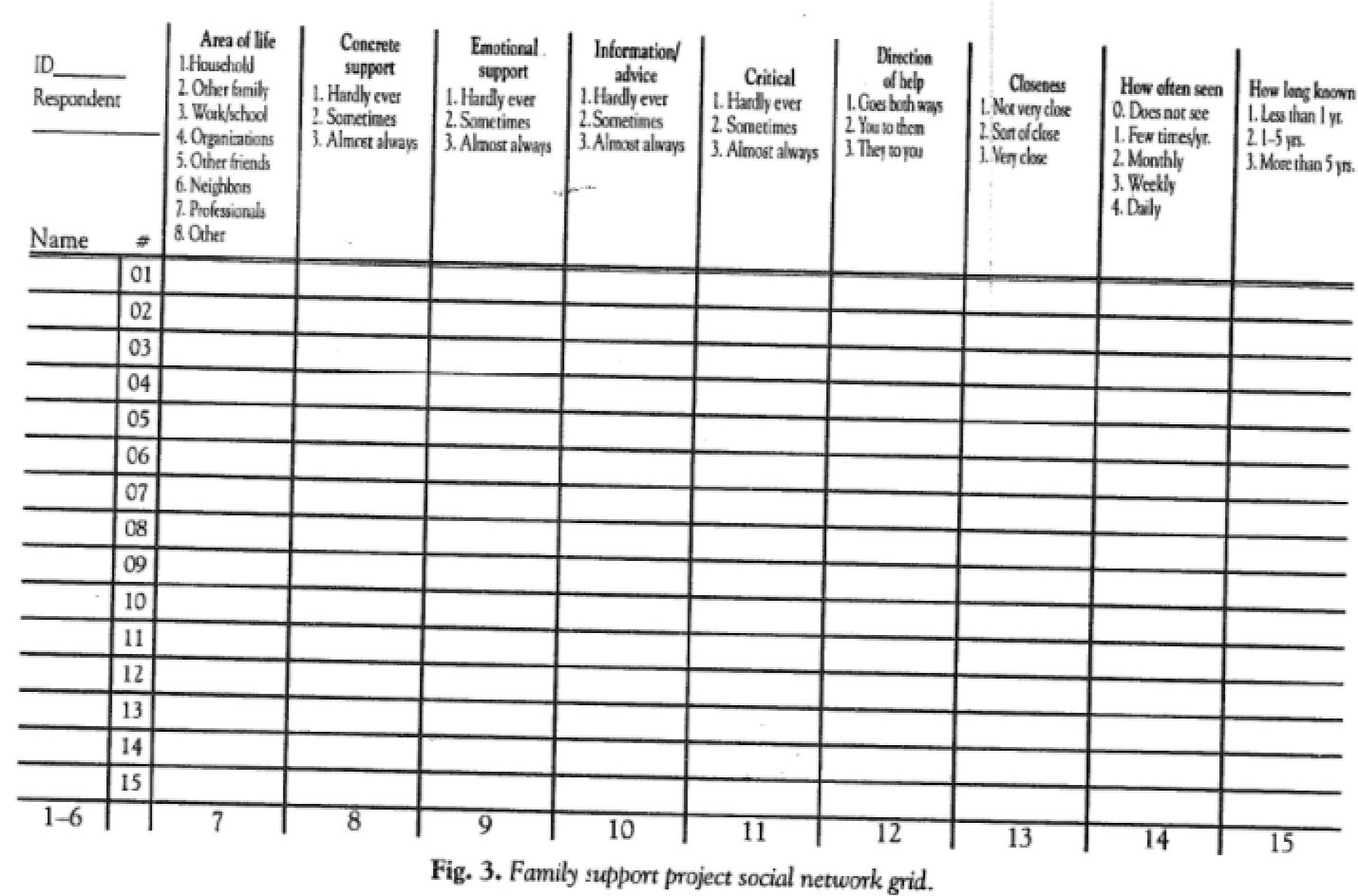
  1. If you want to understand broader networks that students have access to outside of your school or program → Try social network mapping: For decades, social workers have used asset mapping, a close cousin to relationship mapping, in order to assess the support networks of their clients. One example is the Social Network Map, developed by researchers Elizabeth Tracy of Case Western Reserve University and James Whittaker of the University of Washington. Their tool helps case managers identify and sort the structure and quality of a client’s support system by mapping relationships into several categories, including family, peers, friends, and co-workers. Researchers recommend doing multiple rounds of relationship or social network mapping because students may forget to include certain connections that make a difference in their lives. You can gain a more complete picture of who your students know and depend on by revisiting relationship and social network maps. Read more about this approach in the article “The Social Network Map”.


  1. If you’re trying to better understand relationships inside your school or department → Try relationship mapping protocols with your team and students:  Relationship mapping is a strategy that can help schools adjust their practices to effectively forge trusting relationships between students and adults. All it takes is a roster of student names and two sets of different colored stickers for staff to visualize patterns among whom they feel they have a strong relationship with and whom they believe may be at risk for academic, personal, or other reasons. Larger schools and institutions may prefer to move through the process one grade level or department at a time. You can also perform mapping exercises across both staff and students to compare the results. From there, schools that identify students who lack trusting relationships with adults or faculty can direct additional connections and resources accordingly. For example, watch Ted Dintersmith’s Innovation Playlist to see relationship mapping in action at Jamestown Public Schools.


  1. If you’re working in a resource-scarce, human capital-scarce environment → Use relationship and networking mapping as a student project to identify latent resources: Not only does relationship mapping provide more detailed information regarding whom your students know and turn to—it can also surface relationships that you could enlist more deliberately to expand supports or opportunities at your institution. Make sure you have a shared contact database where you can store these connections so that they remain within reach for your community to tap into in the future.


Monday, April 19, 2021

Michael Horn on the Purpose of Schooling

Through much of the 1800s, a kind reading of history would say that the central role of public schools was to preserve American democracy and inculcate democratic values.

In the 1890s and early 1900s, competition with a fast-rising industrial Germany constituted a mini-crisis. The country shifted by creating a new role for public schools: to prepare everyone for vocations. That meant providing something for everyone, with a flourishing of tracks and courses and enrollment in high school.

Another purpose was added to America’s schools in the late 1970s and early 1980s: keeping the country competitive. Although this one had echoes of the prior purpose, it was quite different, as the nation became consumed by how students were doing in school as measured through average test scores.

The vast choices that students had in a “cafeteria-style curriculum,” the landmark report “A Nation at Risk” noted, was one “in which the appetizers and desserts can easily be mistaken for the main courses.” Having something for everyone, in other words, was no longer a virtue. It was a vice.

Just 20 years later, the primary purpose shifted again to asking schools to eliminate poverty by not just focusing on schools’ average test scores, but instead to make sure that children in every demographic, on average, reach a basic measure of proficiency in core subjects. The theory of action, in essence, was that academic achievement would unlock opportunity.

As much of that consensus has eroded in recent years, there has been some drift in the primary purpose of schooling from a political perspective, but what it is at the level of an individual school is a vital conversation to build a coherent model.

Schools tackle this in different ways. A common exercise for a school is to construct a portrait of a graduate to try and understand what an individual entering the world in some number of years would need to be prepared to lead a choice-filled and civically engaged life.

For my part, I’d argue that the goal at a high level is producing students who are prepared to maximize their human potential, build their passions and lead choice-filled lives, participate civically in a vibrant democracy, contribute meaningfully to the world and the economy, and understand that people can see things differently—and that those differences merit respect rather than persecution. As such, I’d encourage schools to think through five domains as they build specifics around their central purpose and priorities:

1. Content knowledge. There’s a mountain of research on the importance of academic achievement and content knowledge across a range of disciplines. After students learn how to read, for example, evidence suggests that the ability to distill the meaning of new passages we confront isn’t so much a skill as something that is derivative of our knowledge base about the topic we’re reading. Building academic achievement to at least a baseline is important for future life success.

2. Skills. The purpose of knowledge isn’t necessarily for its own sake, but so that an individual can do useful things with that knowledge and apply it in ways that make a meaningful contribution. Critical thinking, problem-solving, collaboration, communication, and creativity are vital skills that employers report consistently as being more and more important for their employees. The ability to use these skills, of course, is dependent on having some domain knowledge. As in, I can think critically and communicate well about the future of education (some would agree with that statement anyway!), but if you dropped me in a coding job, for example, I would be lost and unable to apply any of these skills. At the same time, as the example of the Minerva Institute shows—and as is described in Building the Intentional University by Ben Nelson and Stephen Kosslyn, as well as in books like Critical Thinking by Jonathan Haber—these skills can be defined and individuals can learn how to do them in a repeatable and intentional process. As an individual masters these skills in a variety of domains with intentionality—not something the vast majority of schools focus on today—individuals can then more rapidly apply them in new domains as they master its knowledge and lexicon.

3. Habits of success. Also called character skills, social-emotional skills, and noncognitive skills (my least favorite), habits of success revolve around things like self-regulation, executive function skills, growth mindset, self-efficacy, agency, self-direction, and more. Education psychologist Brooke Stafford-Brizard developed a framework around 16 of these habits for Turnaround for Children, which Summit Public Schools has most notably put into action in its schools. These are the sorts of habits that help turn individuals into lifelong learners capable of navigating life’s twists and turns—arguably more important than ever as the half-life of knowledge and skills continues to shrink in the digital age of the knowledge economy. And they can best be modeled, taught, and learned in the context of students’ academic journeys—not as a set of add-on modules.

4. Real-world experiences and social capital. Connecting school to the real world—through projects, extracurricular activities, externships, internships, and more—is important so that students can build a deeper sense for the different ways in which they can contribute to the world, why what they are learning matters, why certain goals are worth attaining, and what resonates with them, among other meaningful opportunities. If the goal of school is not just to ensure students are prepared academically but also that they have access to good life opportunities and careers, then relationships will also be critical. As Julia Freeland Fisher argues in her book, Who You Know, in today’s world, schools need to engage in this activity. After building a baseline of academic knowledge and skills, who you know often trumps what you know in life. And teaching content knowledge, skills, and habits of success in the context of real-world experiences and the cultivation of social capital can be a critical way to ensure success for all students across all these domains.

5. Health and wellness. As schools come back from a challenging time thanks to the pandemic, students will have a variety of different challenges around their social and emotional wellbeing, as well as their more basic health and wellness. Although there’s an argument around whether schools should be involved in these areas, for students to learn effectively, if they aren’t in a sound state in their wellbeing or health, learning will be challenging at best—which means it will land in the domain of schools. On top of that, schools have always played some role in health and wellness—witness the long history of physical and health education in schools. But I’d argue that we’ve often distorted the purpose of these sorts of experiences and that we ought to return to a more foundational one around preparing students to live healthy lives—and being sure to see these domains as not separate from academic learning, but as critically integrated.

If one accepts these baseline ideas, the nuance of how they land in any given schooling community will differ—and the approach to implementing them should likely be personalized based on each student’s distinct needs and background. But as a starting point, taking these domains and building SMART goals that are specific, measurable, attainable, realistic, and time-bound around each would be where I’d advocate starting.

Michael is a co-founder and distinguished fellow at the Clayton Christensen Institute. He currently serves as Chairman of the Clayton Christensen Institute and works as a senior strategist at Guild Education. 

Friday, August 19, 2016

Putting Private Capital to Work for Public Innovation

The Education Department said today it will double down on the Pay for Success model to fund early learning with a $2.8 million grant competition open to states and local governments wishing to study the feasibility of the model in their area.

The Pay for Success model is centered around social impact bonds, where a government agency or contractor pays a service provider for the achievement of pre-established outcomes. Typically, private entities absorb the upfront costs and are reimbursed later.

Among the measurable outcomes that Education Department officials are suggesting: kindergarten readiness, improved social and emotional skills, improved executive functioning, reduction in grade retention and in the need for later special education, reduction in discipline referrals and interactions with law enforcement, and increases in high school graduation.

The grant will fund seven to 14 entities, with awards ranging from $200,000 to $400,000. The dollars are not meant to pay for the implementation of Pay for Success programs, just the development of local feasibility studies.

Education Department officials have praised the results of a PFS program in Utah, where the model has gained the backing of state lawmakers. Backed by Goldman Sachs, it has also garnered criticism for overstated success.


House lawmakers passed a bill to fund social impact bonds in June. 

Tuesday, February 23, 2016

Fixing Our Beliefs


From my friend Jon Haber's excellent blog Degrees of Freedom

Fixing Our Beliefs

So how is one to balance intellectual humility (which asks you to resist the urge to insist you are right, even when you might be wrong) and intellectual courage (which asks you to stick to your guns, even if your argument receives a setback)?  Fortunately, I ended up pondering this conundrum while reading some essays by Charles Sanders Peirce, the father of Pragmatism.

Pragmatism, the only school of the Western philosophical tradition to have originated in America, will be making an appearance more than once between now and Election Day.  For now, however, I just want to focus on how one of the founding documents of this philosophical movement, Peirce’s The Fixation of Belief, can help us navigate the choppy waters between intellectual humility and courage.  In that essay, Peirce proposes that doubt motivates all of our thinking and that all of us constantly generated beliefs large and small in order to dispel the discomfort of doubt.  Once generated, the author describes four ways those beliefs can become fixed in our minds.

One is an a priori method which simply involves believing (or continuing to believe) things that make you comfortable.  This fits well with the human tendency towards cognitive bias which involves only accepting information that supports current beliefs while ignoring facts that conflict with preferred storylines.

Alternatively, one’s beliefs can be established by authority, such as a priesthood (secular or religious) which establishes what is allowed vs. forbidden to think within a society.  Such authority is often challenged by free spirits, many of whom come to their beliefs through tenacity, which involves settling onto a belief system and boldly holding onto it at all costs (regardless of whether it is right or wrong).

While all three of these methods for fixing belief (a priori, authority and tenacity) have something to recommend them, none of them are of much use if your goal is getting to the truth.  If that is your purpose, Peirce proposes science as a model which treats beliefs as conditional, even as more and more experiments are performed and evidence amassed to asymptotically get us closer and closer to ideas likely to be true.